
News
Delhi AQI Hits 451: Diwali Pollution Is Only the Spark, Not the Whole Fire
By MILLENNIUM NEWSROOM Desk · Published: Nov 07, 2026 07:14 PM
3 min read
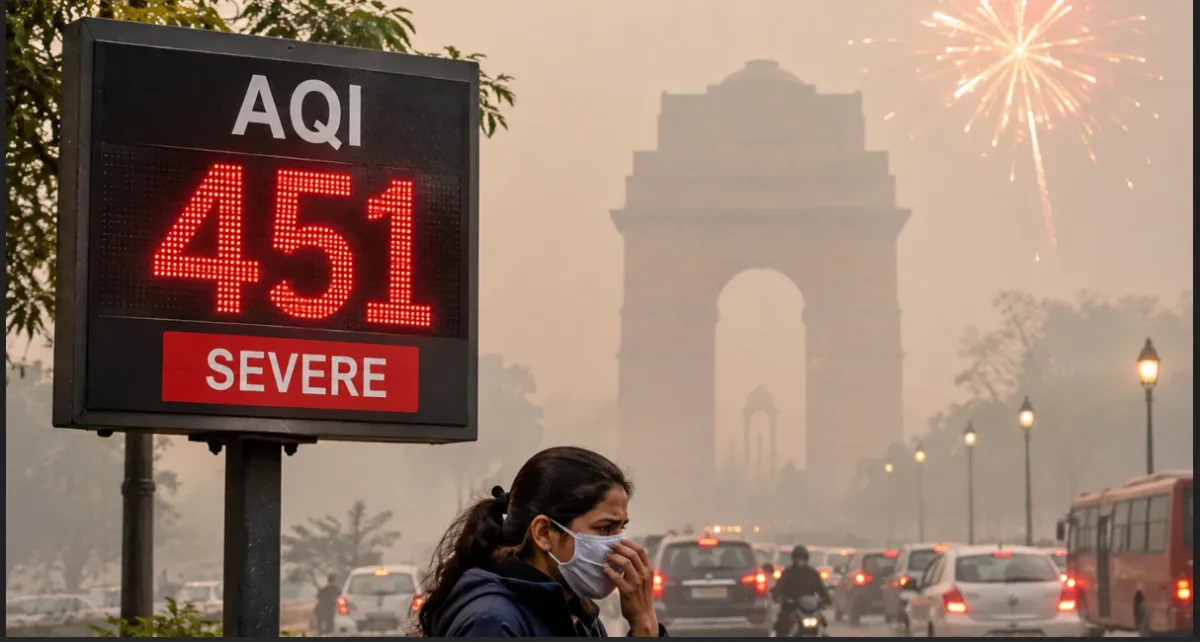
The Delhi AQI has slipped into the danger zone days before Diwali. The Central Pollution Control Board (CPCB) recorded an Air Quality Index of 451 at 8 am on November 3, which falls in the “severe” category. Eight of the capital’s 57 monitoring stations were in the severe band, and 32 more were rated “very poor.” Rohini was among the worst hit at 429. Authorities invoked Stage II of the Graded Response Action Plan (GRAP) across the National Capital Region. These GRAP restrictions are meant to curb pollution as it worsens.
Why the Delhi AQI keeps climbing
Fireworks cause a sharp, short-term rise in fine particulate matter (PM2.5 and PM10). They also release gaseous pollutants and metal-containing particles. But Diwali pollution lands on an atmosphere that is already burdened. Vehicle exhaust, industry, construction dust, waste burning and regional crop-residue fires feed the city’s air year-round.
Winter makes this worse. Low wind speeds, temperature inversions and weak atmospheric mixing trap pollutants close to the ground, so they linger for days.
Also Read:
Noise Pollution During Diwali Can Cause Permanent Hearing Loss, Audiologist Warns
That is why a firecracker ban, though useful, is not a cure. Restricting fireworks can trim the festive spike. It cannot by itself ensure lasting improvement. That needs emission control across sectors, stronger monitoring, better urban planning and greater public awareness.
What an AQI above 400 does to your body
At this level even healthy people can feel adverse effects. Children, older adults, pregnant women and people with heart or lung conditions face far greater risk.
PM2.5 is the main concern. These particles penetrate deep into the lungs, can enter the bloodstream and contribute to systemic inflammation. Symptoms that people often brush off, such as a persistent cough, sore throat, headache, tiredness and breathlessness, can be early warnings. Exposure can also aggravate asthma, respiratory infections and cardiovascular disease.
The World Health Organization’s June 2026 assessment describes air pollution as the leading environmental health risk factor. It is linked to roughly 6.6 million deaths worldwide each year, nearly 84% of them from non-communicable diseases.
Expectant mothers face particular risks:
“Air pollution during pregnancy may increase the risk of preterm birth, low birth weight, restricted foetal growth, stillbirth, high blood pressure and pre-eclampsia. It may also affect placental function and the baby’s lung development and future respiratory health.”
— Dr Anjila Aneja, Executive Director, Obstetrics & Gynaecology, The Women’s Hospital
The indoor air myth
Many Delhiites assume that shutting the door keeps the smog out. The evidence says otherwise:
“One of the biggest misconceptions is that staying indoors automatically protects us from outdoor pollution. In reality, fine particles can infiltrate homes and offices through windows, doors and ventilation systems. Indoor activities such as cooking and burning incense can further increase pollutant concentrations.”
— Dr. Arindam Ghatak, Co-founder & CEO, Biomoneta
Since people spend much of their lives indoors, indoor air quality deserves as much attention as the outdoor AQI. Tracking PM2.5, carbon dioxide, humidity and volatile organic compounds can reveal poor ventilation and hidden exposure risks. Particulate pollution and airborne microbial contamination are separate problems, and each needs its own monitoring and mitigation.
Also Read: