
Education
The Degree Is No Longer the Destination: Why Specialised Courses in India Are on the Rise
By MILLENNIUM NEWSROOM Desk · Published: Nov 03, 2026 08:02 PM
4 min read
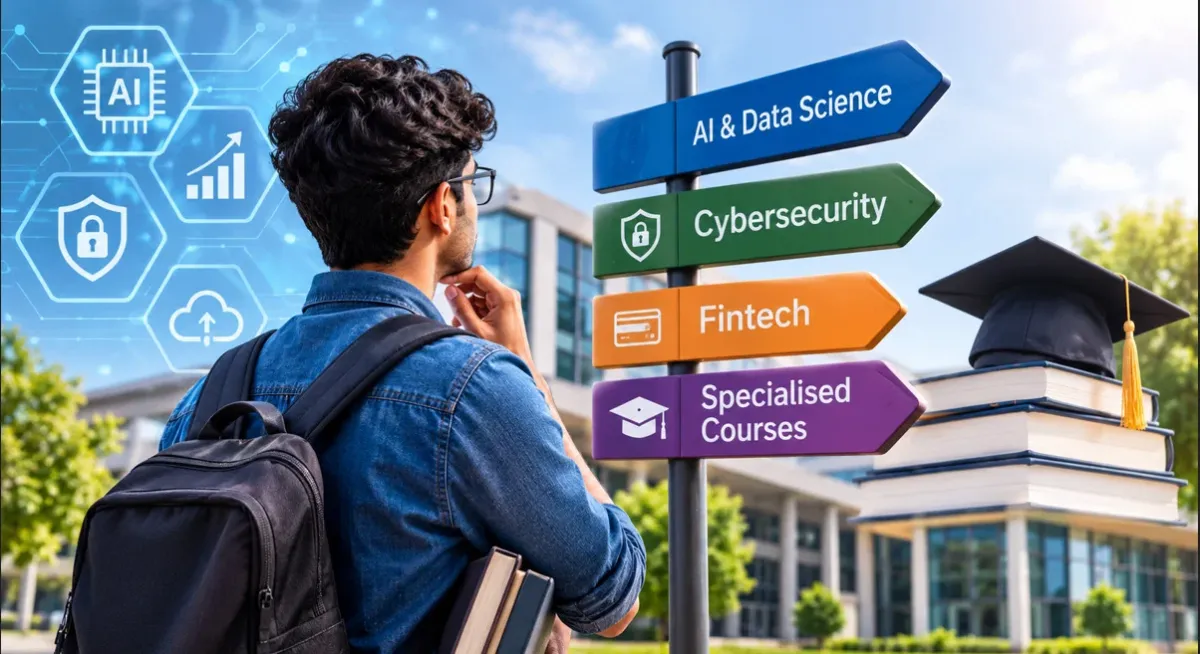
Ask an Indian family what makes a good university today and the answer is rarely its age or its name. It is what happens after graduation. That one question is reshaping how students choose between traditional degrees and specialised courses in India, pushing AI and data science courses, cybersecurity and fintech to the top of the list.
Over the past decade, higher education has become markedly outcome-oriented. Students and families weigh the skills a programme builds, the relevance of its curriculum and its practical exposure, alongside the qualification itself. Universities are responding with specialisations, live projects, certifications and industry interface.
Reputation Now Has to Be Proved
Reputation has not vanished; it has changed meaning. Students treat it as a promise to be tested against verified placement data, faculty quality and alumni careers. With fees a major household commitment, families want a visible link between money spent and career gained.
Also Read:
Teaching Still Remains a Highly Undervalued Profession in India. Say Experts
Survey evidence agrees, with caveats. A FindMyCollege.com study found over half of surveyed students would pick a different college if choosing again, and only about one in five fully trusted published placement figures. Placements, internships and industry exposure disappointed most. A separate school-student survey ranked placement record, rankings and programme design as the top three factors. Both samples are small, so they indicate direction, not verdict.
Technology Meets Domain Knowledge
Artificial intelligence, data science, cybersecurity, machine learning and fintech increasingly shape how students judge programmes. The bigger story is integration: computer science is being fused with generative AI, analytics and fintech, while management and technology programmes now add financial technology and AI. The pattern is spreading to public policy and clinical psychology.
"The shift is not necessarily away from conventional degrees, but towards more flexible learning pathways that help students build domain knowledge alongside technology, analytical and industry-relevant skills. Universities are therefore responding by integrating specialisations, industry interface, live projects, certifications and experiential learning into programmes."
— Dr. Sami Anand, Assistant Professor & Additional Dean, Head – Training and Placement, CSE & IT, LPU
What the Numbers Say, and What They Don't
The India Skills Report 2026, prepared by ETS, CII, AICTE, AIU and Taggd, puts overall graduate employability at 56.35 per cent. Computer Science graduates scored 80 per cent and IT graduates 78 per cent. MBA employability slipped to 72.76 per cent from 78 per cent, while commerce rose to 62.81 per cent, science stood at 61 per cent and arts at 55.55 per cent. Job-ready skills in AI, data and cloud appear to be rated highest, and a general management degree no longer guarantees the same edge. But these figures measure assessed readiness, not actual hiring or pay.
Also Read:
NEET Paper Leak to CJP Protests: Why India Needs Lasting Exam Reforms Beyond Crisis Management
Salary evidence comes mostly from abroad. NACE found that 55 per cent of paid interns in the US Class of 2026 who applied for jobs received an offer, averaging $69,521 against $61,747 overall. Another NACE study put average pay at $59,059 for graduates with experiential learning against $44,048 without. This is American data, and strong candidates may simply win better internships. India has no reliable national dataset comparing specialised and general graduates, and institutional placement figures are not always independently verified.
When a Traditional Degree Still Wins
Specialised graduates often start faster because training matches an immediate job. Over ten or fifteen years, progress leans on judgment, communication and leadership, which broader education tends to build, and a narrow skill can date quickly. Regulated professions such as pharmacy, medicine and law demand statutory qualifications; research and doctoral paths need a strong academic base; and undecided students gain from a broader foundation.
"In my view, the choice is not between skills and degrees. A good programme, whether specialised or broad, should teach the subject properly, give real work exposure, and publish honest outcomes. Students should compare programmes on these points and not on labels alone."— Dr. Somnath P. Patil, Pro-Chancellor, Dnyaan Prasad Global University (DPGU), by Dr. D. Y. Patil Group, Pune
The Bottom Line: Choose Evidence, Not Labels
Wider data suggests the shift is structural. AICTE figures reported by Careers360 in October 2025 show B.Tech seats filled rising from 53.73 per cent in 2020-21 to 75.07 per cent in 2024-25, led by computer science, while mechanical and civil enrolments have fallen since 2022-23. Business Today reported in January 2026 that business schools are adding AI and data analytics, and the Indian School of Business has lengthened its MBA to 20 months.
Also Read:
Why More Indian Students Are Choosing to Study Abroad: From Global Exposure to Career Investment
A boom, however, carries a warning. When seats crowd into one fashionable stream, the label stops differentiating graduates; depth and verified work exposure do. Before paying a fee, students can ask: Is course-wise placement data available? What do students actually do in industry partnerships? Is the degree UGC-recognised? Programmes that answer all three beat any trending title.