
Healthcare
Noise Pollution During Diwali Can Cause Permanent Hearing Loss, Audiologist Warns
By MILLENNIUM NEWSROOM Desk · Published: Oct 27, 2026 07:07 PM
4 min read
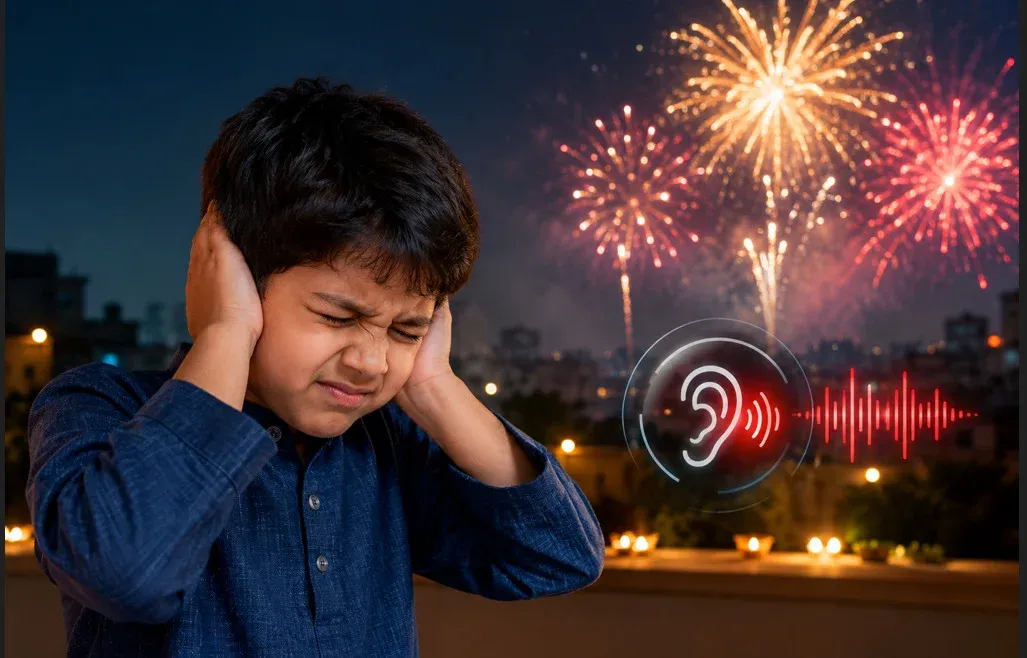
As Diwali skies erupt in light and sound, a quieter emergency unfolds inside the human ear. Noise pollution during Diwali, driven by firecrackers, chocolate bombs and booming loudspeakers, can cause permanent hearing loss in a single moment. Clinics typically report a predictable rise in ear complaints once the festival ends, and much of that harm is preventable.
Why the ear cannot recover
Chocolate bombs, the strong cracker bombs often lit in a row, and high-volume music push the ear far past its limits.
"Deep inside the cochlea, there are thousands of tiny hair cells that turn sound into signals for the brain. Once these cells are damaged, the body cannot grow them back. Very loud sounds from firecrackers, chocolate bombs and loudspeakers can hurt these cells, sometimes in a single moment," says Mrs Vishakha Maurya, Lead Audiologist, Centre for Hearing®, the flagship retail brand of Anand Hearing Care Pvt. Ltd.
How loud is too loud?
Everyday conversation sits near 60 decibels. Sounds above 85 decibels can slowly harm hearing over several hours, and safe listening time shrinks fast as volume rises. At about 100 decibels, damage can begin in 15 minutes. Many firecrackers, however, produce a sharp burst of 120 to 150 decibels or more at close range, so harm can occur in a fraction of a second.
Also Read:
Precision Healthcare in India Depends on Smarter Medical Equipment Management
Duration still counts. Long evenings of loud music or nearby crackers add up, and tired, dull-feeling ears are a warning. With firecrackers, though, suddenness matters even more. A single close explosion can cause acoustic trauma: permanent hearing loss, tinnitus (constant ringing or buzzing) and sometimes a ruptured eardrum, which often brings sharp pain, sudden hearing loss and occasional bleeding. Many eardrum tears heal with proper care, but accompanying inner-ear damage can last.
What clinics see afterwards
In the days after Diwali, ENT doctors typically see more cases of tinnitus, muffled hearing, ear pain, dizziness and trouble following conversations in a crowd.
These illustrative cases are general examples, not any one person's details. A man in his twenties ignored a sharp pain and whistling after a cracker bomb exploded near his left ear. A test two days later showed a clear drop in higher pitches. Timely treatment and rest from noise restored much of his hearing, but mild ringing lingered for months. An eight-year-old watching his father light a cracker from a short distance could not hear properly afterwards; a check-up found a small eardrum tear, which healed with care.
"I often tell people that 'it went away on its own last time' is not a guarantee for next time. Every loud exposure can add to the damage, and the effects can quietly build up over the years," says Mrs Vishakha Maurya, Lead Audiologist, Centre for Hearing®.
Children, who like to stand close to crackers and rarely grasp the danger, are especially at risk, as are elderly people and babies.
Also Read:
India’s Heart Health Crisis Is Moving Into Younger Age Groups
Protecting your hearing
Distance is the simplest defence. Most safety guidelines suggest staying at least 5 to 10 metres from lit firecrackers, and farther from bombs and aerial items. Light them in open areas, never in narrow lanes, closed courtyards or near walls, because sound bounces back. Never hold a cracker or lean over it. Use a long incense stick or long-handled lighter, and move away at once. Choose quieter fountains and sparklers.
Properly fitted earplugs reduce noise by roughly 15 to 30 decibels. Earmuffs offer similar protection and are easier for children to wear; using both gives more, though no gear makes an extremely loud blast completely safe. Cotton wool offers little protection. Options include custom-made earplugs or foam types such as Hearos Xtreme Protection Series (NRR 33) and 3M 1110 Polyurethane Foam Earplugs (NRR 29).
Hearing aid users
Hearing aids amplify sound, so switch them off or remove them near firecrackers. Avoid going without them in busy places for long, as you may miss horns or calls for help. Keep them on during quieter family moments, step into a quiet room during the loudest blasts, and store devices in a dry box. Agree on simple signals with family, and keep a phone nearby with flashing or vibration alerts.
Also Read:
From Skepticism to the Second Opinion. How Homoeopathy Is Rewriting Its Story in India
When to see an ENT specialist
Mild ringing that fades within hours is usually temporary stress on the ears. Seek help for sudden hearing loss, sharp or lasting ear pain, bleeding or fluid, dizziness, nausea, or ringing lasting beyond a day or two. A child who keeps touching an ear or stops responding to sound also needs prompt attention. If symptoms persist after 24 hours, do not wait.
Keep the ear dry and put nothing inside it, including cotton buds, oils or drops. Visit an ENT specialist urgently: steroid treatment, when clinically indicated, works best ideally within 48 hours.