
Sports
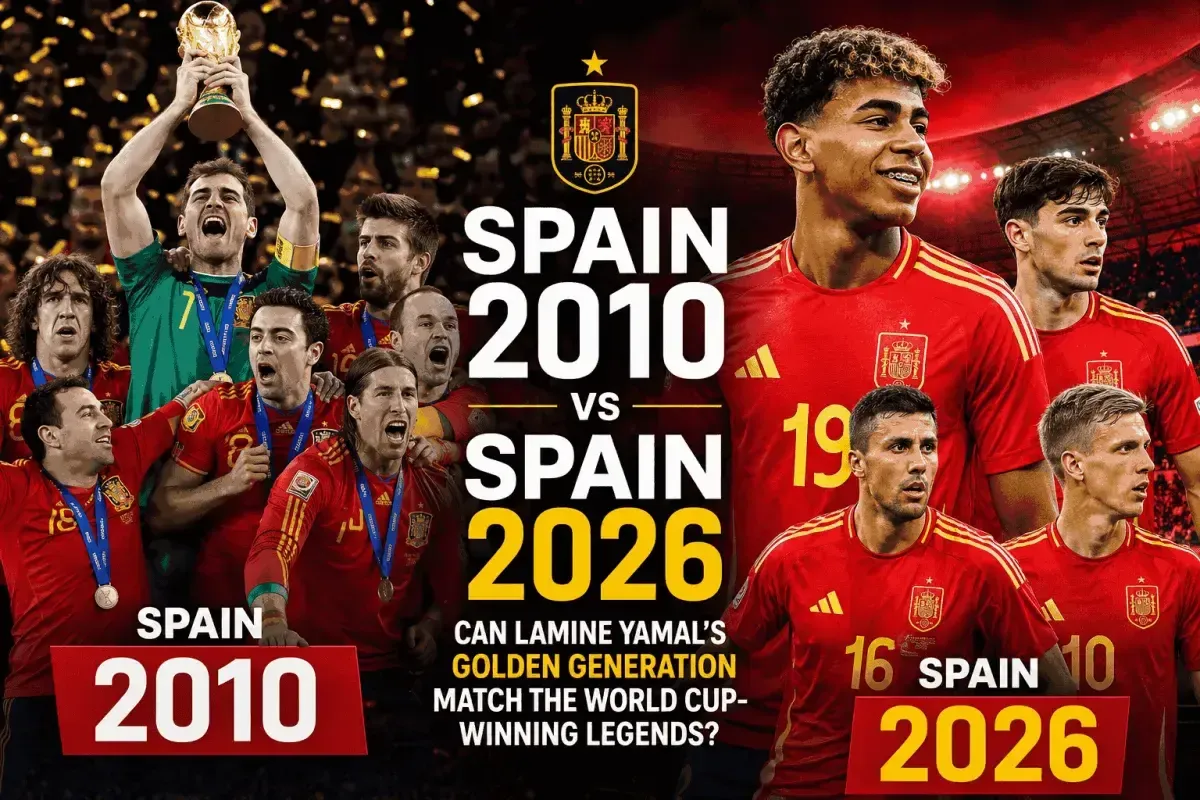
Spain 2026 vs Spain 2010: Can Lamine Yamal's Golden Generation Match the World Cup-Winning Legends?
By MILLENNIUM NEWSROOM Desk · Published: Jun 22, 2026 02:59 PM · Updated: Jul 17, 2026 03:23 AM
12 min read
Spain's New Golden Generation Has Arrived
For nearly a decade after lifting the FIFA World Cup in South Africa, every Spanish national team was measured against one benchmark—the immortal class of 2010. That squad, led by Vicente del Bosque, transformed football forever. Their patient possession game, flawless technical ability and tactical intelligence made them one of the greatest international teams in history.
Names like Iker Casillas, Carles Puyol, Gerard Piqué, Sergio Ramos, Xavi Hernández, Andrés Iniesta, Xabi Alonso, Sergio Busquets, David Villa and David Silva became symbols of footballing excellence. Between 2008 and 2012, Spain won two UEFA European Championships and one FIFA World Cup, a feat unmatched in modern international football.
For years, the question remained the same: Would Spain ever produce another generation capable of reaching those extraordinary heights?
Following Spain's commanding 4-0 victory over Saudi Arabia in the FIFA World Cup 2026, that question suddenly feels more relevant than ever. The performance showcased a team brimming with confidence, tactical maturity and attacking flair. While one impressive victory does not guarantee silverware, it reinforced the growing belief that this Spanish squad possesses the quality, balance and mentality required to compete for football's biggest prize.
The comparisons with the 2010 champions are inevitable. Yet this is not a story about replacing legends. Instead, it is about how a new generation has embraced Spain's footballing identity while evolving it for the modern game.
Two Different Eras, One Footballing Philosophy
At first glance, the two squads appear remarkably similar. Both prioritize possession, technical excellence and intelligent movement. However, the way they execute those principles reflects two very different eras of football.
The 2010 side perfected "tiki-taka" football. Every pass had a purpose. Matches were controlled through relentless possession rather than overwhelming attacking numbers. Spain often suffocated opponents by denying them the ball altogether.
Today's team under Luis de la Fuente plays with noticeably greater verticality. Possession remains important, but it serves as a platform for quick transitions, aggressive pressing and rapid attacks rather than an end in itself.
This evolution reflects how football itself has changed. Modern teams defend higher, press more intensely and transition faster than ever before. Spain has adapted without abandoning the technical identity that made them world champions sixteen years ago.
That tactical flexibility could become one of their greatest strengths as the tournament progresses.
Goalkeepers: Unai Simón Following Casillas' Giant Footsteps
No comparison is more daunting than replacing Iker Casillas.
Captain of the 2010 champions, Casillas was more than a goalkeeper. He was Spain's emotional leader. His remarkable save against Arjen Robben in the World Cup final remains one of football's defining moments, preserving Spain's historic victory.
Unai Simón faces an impossible benchmark, yet he has quietly established himself among Europe's most dependable goalkeepers.
While Casillas was renowned for extraordinary reflexes and spectacular one-on-one saves, Simón represents the modern goalkeeper—comfortable with the ball at his feet, confident in building attacks from the back and capable of acting as an additional defender.
The styles differ, but both provide something equally valuable: calmness.
Spain's defenders trust Simón exactly as Puyol and Piqué trusted Casillas sixteen years earlier.
Defence: New Faces Carrying the Legacy of Puyol and Piqué
If one area defined Spain's 2010 success beyond midfield dominance, it was defensive composure.
Carles Puyol embodied courage, leadership and relentless determination. Gerard Piqué introduced elegance, anticipation and elite ball distribution. Together, they formed one of international football's greatest defensive partnerships.
The 2026 generation lacks that level of experience, but its potential is extraordinary.
Pau Cubarsí — Spain's Next Defensive Prodigy
Few teenagers have entered international football with the composure displayed by Pau Cubarsí.
Much like Gerard Piqué during his prime, Cubarsí possesses exceptional passing ability, positional intelligence and confidence under pressure. Rather than simply clearing danger, he begins attacks from deep positions.
At just 19 years of age, he already demonstrates the maturity normally associated with experienced internationals.
If his development continues, Spain may once again possess one of the world's finest ball-playing centre-backs.
Dean Huijsen Brings Modern Defensive Versatility
Alongside Cubarsí, Dean Huijsen represents another exciting evolution of Spain's defensive philosophy.
Tall, technically gifted and fearless in possession, Huijsen reflects the changing demands placed upon central defenders. Modern centre-backs are expected to initiate attacks as effectively as they prevent them.
Together, Cubarsí and Huijsen offer Spain something remarkably similar to the Piqué-Puyol partnership: complementary strengths built upon outstanding technical quality.
Full-Backs: Different Profiles, Same Importance
Spain's full-backs have always played crucial tactical roles.
In 2010, Sergio Ramos combined relentless attacking runs with defensive discipline, while Joan Capdevila quietly balanced the opposite flank.
Today's team features Pedro Porro and Marc Cucurella, two players whose attacking instincts perfectly suit Luis de la Fuente's system.
Porro constantly overlaps wide attackers, stretching defensive lines and creating numerical superiority.
Cucurella, meanwhile, has developed into one of Europe's most reliable left-backs. His relentless work rate mirrors Capdevila's consistency, although he contributes more aggressively in advanced positions.
Modern football demands greater attacking output from full-backs, and Spain's current options provide precisely that.
Midfield: Can Anyone Truly Replace Xavi and Iniesta?
Every discussion about Spain inevitably arrives at midfield.
Perhaps no partnership has ever controlled football matches quite like Xavi Hernández and Andrés Iniesta.
Their understanding bordered on telepathic.
They dictated tempo, escaped pressure effortlessly and manipulated opponents through endless combinations of short passing.
Replacing such players is impossible.
Matching their collective influence, however, may not be.
The responsibility now falls upon Rodri, Pedri and Dani Olmo, three footballers who represent Spain's new creative heartbeat.
Rodri: The Modern Successor to Busquets and Xabi Alonso
Rodri has already established himself as arguably the finest holding midfielder in world football.
Unlike Sergio Busquets, whose genius often appeared understated, Rodri combines tactical intelligence with greater physical presence and goalscoring ability.
He also inherits aspects of Xabi Alonso's game—long-range passing, leadership and an ability to dictate rhythm from deep positions.
In many ways, Rodri represents the evolution of both legends.
He protects the defence, launches attacks, wins aerial duels and frequently contributes decisive goals.
Every great international team requires a controlling figure capable of influencing every phase of play.
For Spain in 2026, Rodri is unquestionably that player.
Pedri: The Closest Spain Has Come to Producing Another Xavi
If there is one player in the current Spanish squad who naturally evokes memories of Xavi Hernández, it is Pedri.
Comparisons with one of football's greatest midfielders are often unfair, but Pedri possesses qualities that make them almost unavoidable. Like Xavi, he thrives in tight spaces, always seems to have an extra second on the ball, and rarely makes the wrong decision under pressure. His first touch, spatial awareness and ability to dictate the tempo of a match have already placed him among the finest midfielders of his generation.
Where Xavi was the master conductor of Spain's legendary orchestra, Pedri is gradually becoming the team's rhythm setter. His game is built on intelligence rather than physicality. He constantly scans the field, identifies passing lanes before they appear, and keeps Spain's attacking structure fluid.
There are, however, notable differences. Modern football demands more verticality and athleticism than the era in which Xavi dominated. Pedri carries the ball forward more frequently, presses aggressively without possession, and contributes higher up the pitch. His versatility allows Luis de la Fuente to alter formations during matches without disrupting Spain's rhythm.
He may never replicate Xavi's astonishing international legacy, but he has inherited the responsibility of orchestrating Spain's midfield—a responsibility he continues to embrace with remarkable maturity.
Dani Olmo: Not Another Iniesta, but Spain's New Creative Spark
No player could truly replace Andrés Iniesta.
The man who scored the winning goal in the 2010 FIFA World Cup Final remains one of the greatest midfielders football has ever witnessed. Iniesta's elegance, humility and extraordinary ability to decide the biggest matches elevated him into footballing immortality.
Dani Olmo does not attempt to imitate him. Instead, he offers creativity in a distinctly modern way.
Where Iniesta relied on graceful dribbling and delicate combinations, Olmo thrives on directness. He constantly attacks defensive lines, makes intelligent runs into dangerous spaces and possesses an eye for goal that has become increasingly valuable for Spain.
Against Saudi Arabia, Olmo once again demonstrated why he has become indispensable. His movement between midfield and attack repeatedly unsettled the opposition, creating space not only for himself but also for Spain's explosive wide players.
Iniesta often controlled matches quietly.
Olmo influences them dynamically.
Both achieve the same objective—unlocking stubborn defences—but through different footballing languages.
Lamine Yamal: Carrying the Legacy of David Villa, Pedro and David Silva
Perhaps no player symbolises Spain's future more than Lamine Yamal.
Still only a teenager, Yamal has already established himself as one of world football's most electrifying attackers. His confidence, creativity and fearlessness have made him one of the first names on Luis de la Fuente's team sheet.
Yet comparing him with just one player from 2010 does not tell the full story.
In many respects, Yamal combines qualities that once belonged to several Spanish legends.
Like Pedro Rodríguez, he stretches defences with relentless movement and intelligent positioning. Pedro's tireless off-the-ball runs created countless opportunities for Spain in 2010. Yamal performs a similar tactical function but with considerably greater flair in one-on-one situations.
His dribbling ability and vision also evoke memories of David Silva. Silva was renowned for manipulating defenders in tight spaces and creating chances that others simply could not see. Yamal has already demonstrated a similar ability to unlock compact defensive structures through his close control and imagination.
When it comes to decisive moments, however, the comparisons inevitably shift towards David Villa.
Villa remains Spain's all-time leading goalscorer and was unquestionably the team's attacking talisman during the 2010 World Cup. Time and again, he produced moments of individual brilliance that rescued Spain in tightly contested matches.
Yamal's role differs tactically, but his capacity to influence the biggest games appears strikingly familiar.
He may not yet possess Villa's clinical finishing, but he carries the same aura—the sense that whenever he receives possession, something extraordinary might happen.
If Spain are to lift another World Cup, Lamine Yamal will almost certainly be central to that journey.
Mikel Oyarzabal and Spain's New Attacking Identity
Replacing a striker like David Villa is arguably the most difficult challenge any Spanish generation has faced.
Villa combined lethal finishing with tireless movement and remarkable composure in front of goal. Many of Spain's narrow victories in South Africa were decided by his clinical instincts.
Mikel Oyarzabal is a different type of forward.
Rather than serving as an out-and-out goalscorer, he functions as a complete attacking player. His intelligent pressing, ability to link play and positional flexibility allow Spain's fluid attacking system to function effectively.
His winning goal in the UEFA Euro 2024 Final demonstrated his composure on the biggest occasions, while his work ethic perfectly reflects the collective philosophy that has always defined Spanish football.
Goals may come from several players rather than one superstar striker, but that unpredictability makes Spain even more dangerous.
Squad Depth: One Area Where 2026 May Surpass 2010
One of the most overlooked aspects of the current Spanish squad is its remarkable depth.
The 2010 team possessed one of football's greatest starting elevens, but beyond that core group, there were comparatively fewer game-changing options from the bench.
The 2026 squad presents a different picture.
Players such as Nico Williams, Álex Baena, Fermín López, Martín Zubimendi and several emerging young talents provide Luis de la Fuente with tactical flexibility that Vicente del Bosque rarely enjoyed.
Spain can alter formations, increase attacking intensity or strengthen midfield control without significantly reducing overall quality.
In modern tournament football, where matches arrive every few days and squad rotation is essential, that depth could become one of Spain's greatest advantages.
Winning the World Cup requires far more than a brilliant first eleven.
It requires twenty-three players capable of performing under immense pressure.
Spain appears to possess exactly that.
Experience Meets Youth: The Formula Behind Spain's Revival
Perhaps the greatest similarity between the 2010 champions and the current squad lies not in individual players but in team balance.
The South African champions blended experienced leaders like Casillas, Puyol, Xavi and Villa with players entering their peak years.
The 2026 squad follows a remarkably similar blueprint.
Rodri, Dani Olmo, Unai Simón and Mikel Oyarzabal provide leadership and tournament experience.
Around them, extraordinary young talents such as Lamine Yamal, Pau Cubarsí, Pedri and Dean Huijsen bring energy, fearlessness and limitless potential.
This balance creates an environment where youth can flourish without carrying the entire burden of expectation.
It is a formula that has produced champions before.
There is every reason to believe it could do so again.
Can Spain Win the FIFA World Cup 2026?
Comparisons with the legendary 2010 squad will continue throughout the tournament, and rightly so. That generation established a benchmark few international teams have ever reached.
However, attempting to measure every player against a legend misses the broader picture.
This Spain side does not need another Xavi, another Iniesta or another David Villa.
It needs to become the best version of itself.
The evidence is increasingly convincing.
Rodri has become the world's premier midfield controller.
Pedri continues to evolve into one of football's finest playmakers.
Dani Olmo consistently delivers creativity and goals in equal measure.
Pau Cubarsí and Dean Huijsen represent the future of Spanish defending.
Above all, Lamine Yamal has emerged as the kind of generational talent capable of defining an era.
Spain's emphatic victory over Saudi Arabia was more than just three points. It was a statement of intent. It demonstrated a team playing with confidence, tactical intelligence and a clear identity—qualities that once defined the champions of 2010.
Football history rarely repeats itself in exactly the same way.
The tiki-taka revolution that conquered the world sixteen years ago belongs to another era. Luis de la Fuente's Spain has embraced a faster, more direct and more versatile style while preserving the technical excellence that has always distinguished Spanish football.
Whether this generation ultimately lifts the FIFA World Cup remains uncertain. International tournaments are often decided by fine margins, moments of brilliance and a little fortune.
Yet one conclusion is becoming increasingly difficult to ignore.
The names on the back of the shirts may have changed.
The philosophy remains unmistakably Spanish.
And for the first time since that unforgettable night in Johannesburg, it genuinely feels as though Spain possesses a squad capable of adding another golden chapter to one of football's richest histories.
(AI generated image)