
Healthcare
Why is it better to go for a robotic knee replacement surgery than a conventional one?
By MILLENNIUM NEWSROOM Desk · Published: Sep 03, 2026 07:36 PM · Updated: Sep 03, 2026 11:17 PM
5 min read
Imagine a surgeon's steady hand amplified by a machine that never blinks, never tires, and maps your knee's unique anatomy down to the millimeter before a single incision is made. This is the quiet revolution behind robotic knee replacement surgery, a shift from the standardized, one-size-fits-all approach of conventional techniques to something deeply personalized. While traditional knee replacement has reliably served patients for decades, robotic-assisted systems bring a new level of precision to implant positioning and joint alignment, consistently outperforming manual methods in accuracy according to recent analysis by industry experts.
The technology isn't about replacing the surgeon's expertise, it's about sharpening it, reducing the guesswork that even skilled hands can't always eliminate. As adoption grows worldwide and health systems increasingly recognize its value, robotic knee replacement is emerging not as a passing trend, but as a meaningful evolution in how we restore mobility and quality of life.
Robotic knee replacement comes in two types, active and passive. In both, the surgeon stays in control. The robot assists, it does not take over. The real difference is precision. With robotic surgery, the implant goes in at the exact planned angle every single time, with accuracy down to less than half a millimetre. In conventional surgery, the error margin can be up to 2 mm.
This level of precision ensures the knee is aligned properly, which is key to making the replacement last longer. “Robotic systems also need less cutting and less disturbance to the soft tissues around the knee. That means less pain after surgery, less stiffness, and patients get moving sooner”, says Dr. Brigadier (Dr.) Barun Datta, Senior Consultant - Orthopaedic Surgery, Narayana RN Tagore Hospital, Kolkata.
Therefore it is established that the robot analyses the anatomy and provides inputs on what would be appropriate. This allows the surgery to be planned and executed with computer guidance and robotic assistance, moving from a “one-size-fits-most” approach towards a more customised knee replacement.
It has only been a few years that robotics technologies are being used for knee replacement surgeries. This is the reason why long-term data is not currently available when it comes to robotic knee replacement. But from the experience gained by expert surgeons in the past few years, they conclude that it is a good choice to make. Studies show robotic surgery gives better alignment on X rays and patients report less pain, better function, and faster recovery.
Also Read: India’s Food Safety Problem Is No Longer Just About Adulteration
The biggest benefit here is consistency. No matter who performs the surgery or where, the alignment stays the same. With conventional tools, there can be up to a 3 degree difference between surgeons. “Current research at one to two years shows broadly similar outcomes between robotic and conventional knee replacement, but robotic surgery can offer lesser pain and an earlier feeling of having a normal knee”, mentions Dr. Mukunth Krishnamoorthy, Senior Robotic Joint Replacement Surgeon, Kauvery Hospital, Chennai.
The aspect of personalisation deeply reflects in the robotic knee replacement process. With active robotic systems, the treatment starts with a CT scan of the entire lower limb, from hip to ankle. This scan maps out the patient's bone structure and natural alignment. Unlike conventional surgery, which uses standard cutting guides for everyone, robotic surgery lets the surgeon plan the procedure around each person's specific anatomy. The implant is positioned to match how that individual's knee naturally sits, making the surgery truly personalised.
It also helps assess the fact that the alignment of one knee may not necessarily be the same as the other. In a very crooked knee, for example, there may not always be a need to straighten it excessively simply to make the X-ray look perfect if that could result in more pain. These factors can be discussed with the patient to determine an approach that provides a more natural-feeling knee while considering the patient’s expectations and clinical requirements.
Experts are also of the opinion that robotic-assisted surgery helps preserve more healthy bone and soft tissue during the procedure. The robotic arm moves freely in all directions and can work through a small space between the bones without needing to dislocate the knee, which is often required in conventional surgery. “The system tells us exactly how much bone to remove and from where. This means we take out only what is needed to fit the right sized implant. In conventional surgery, extra bone cuts and soft tissue releases are sometimes needed to balance the knee, which can mean using thicker implants. With robotics, we preserve more of the patient's natural bone and tissue”, says Dr. Datta.
Also Read: Modern Indian Lifestyle Is Rewriting Human Fertility: Are We Paying the Price for Economic Growth?
Today's robotic systems use CT scans or live navigation during surgery. The next step is adding artificial intelligence, 3D modelling, and gait analysis. By studying how a patient walks before surgery, surgeons can understand their movement patterns and plan the knee replacement to match their natural biomechanics. Putting robotics together with AI, 3D planning, and gait analysis will help surgeons recreate each patient's anatomy more closely, leading to better function and satisfaction after surgery. “As these technologies develop, knee replacement could become more precise and consistent. Technology will continue to assist the surgeon rather than replace surgical judgement”, concludes Dr. Krishnamoorthy.
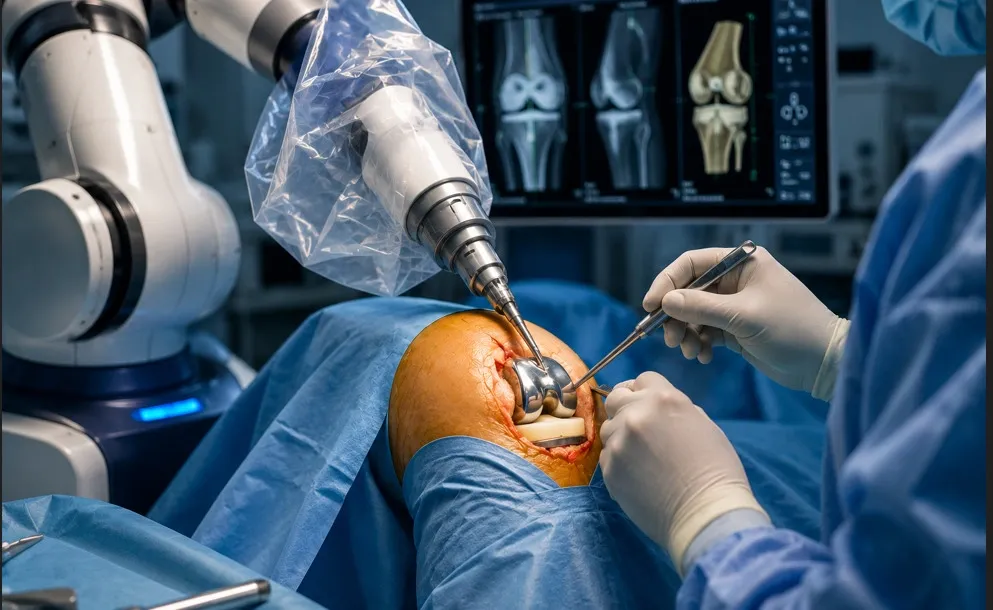
(AI generated image)