
World news
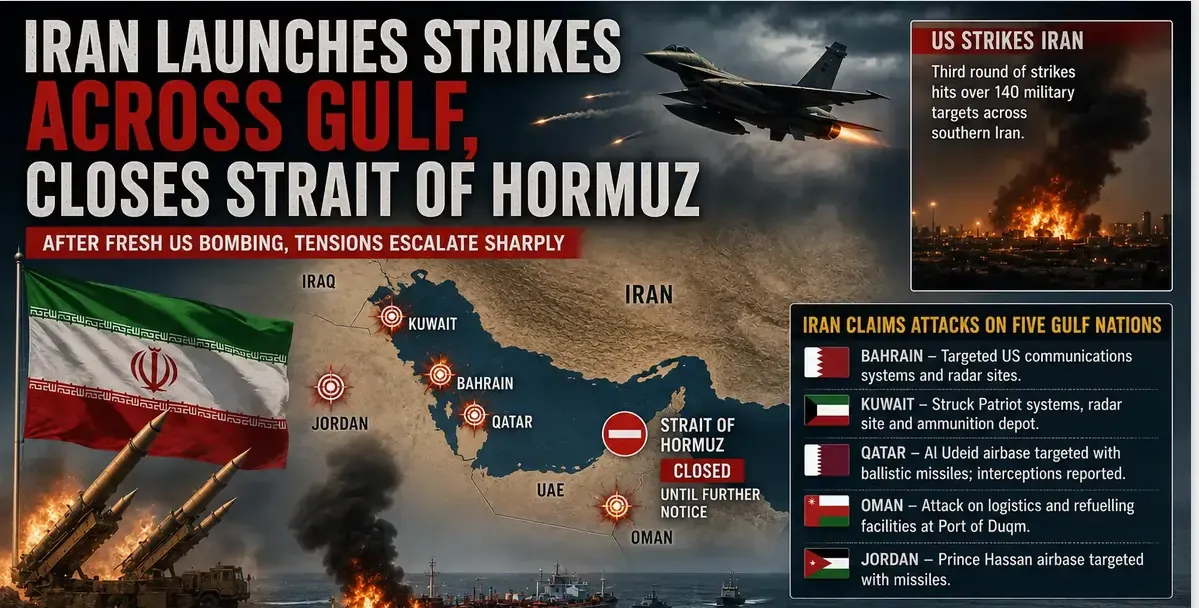
Iran Launches Strikes Across Gulf, Closes Strait of Hormuz After Fresh US Bombing
By MILLENNIUM NEWSROOM Desk · Published: Jul 13, 2026 12:33 AM
3 min read
Middle East conflict enters dangerous new phase
The conflict between the United States and Iran escalated sharply on Sunday after Tehran launched missile and drone attacks targeting US-linked military facilities across multiple Gulf nations and announced the closure of the Strait of Hormuz following a fresh round of American airstrikes.
The latest developments mark one of the most serious military escalations since Washington and Tehran signed a memorandum of understanding (MoU) in June aimed at reducing hostilities and creating a pathway for negotiations. However, both countries have repeatedly accused each other of violating the agreement, with recent military exchanges effectively derailing the peace process. Reuters and the Associated Press reported that the latest attacks followed a third round of US strikes on Iranian military infrastructure in the past week.
Iran responds after fresh US strikes
According to US Central Command (CENTCOM), American forces targeted around 140 military sites across Iran, including missile launch facilities, drone infrastructure, coastal surveillance systems, communications networks and naval assets. US officials said the strikes were carried out in response to recent Iranian attacks on commercial shipping in the Strait of Hormuz.
Iranian state media reported explosions in several provinces, including Bushehr and Lorestan, while officials said assessments of casualties and damage were still underway.
Tehran claims attacks across Gulf region
In retaliation, Iran claimed to have launched coordinated missile and drone attacks targeting US military facilities in Bahrain, Kuwait, Qatar, Oman and Jordan. Authorities across several Gulf nations activated air defence systems, while residents in some areas reported hearing explosions and air raid sirens.
Qatari officials said air defence systems intercepted incoming projectiles, though authorities reported injuries caused by falling debris. Kuwait and Bahrain also confirmed defensive operations against aerial threats while condemning the attacks.
Iran announces closure of Strait of Hormuz
Iran also declared the Strait of Hormuz closed until further notice, accusing the United States of violating the June agreement and threatening regional security.
The Strait of Hormuz remains one of the world's most strategically important maritime chokepoints, with roughly one-fifth of global oil supplies passing through the narrow waterway. The announcement immediately intensified concerns over global energy markets and international shipping. Reuters reported that oil prices climbed sharply as investors reacted to the renewed conflict.
Iran blames US for collapse of agreement
Iranian Parliament Speaker Mohammad Bagher Ghalibaf defended Tehran's response in a statement posted on X.
"The era of one-sided deals is over."
"We told you: keep your word or pay the price. Reality is knocking."
According to Iranian officials, the latest US strikes represent another violation of the memorandum signed last month, which was intended to facilitate negotiations and reduce military activity in the region.
Regional tensions continue to rise
Governments across the Gulf condemned the attacks and heightened security measures. Oman said it was taking all necessary steps to protect residents, while Qatar described the attacks as a serious violation of its sovereignty.
"The continuation of these aggressions represents a dangerous escalation that will complicate efforts aimed at containing tensions, undermine political and diplomatic endeavors aimed at achieving security and stability in the region, and holds the Islamic Republic of Iran fully legally responsible for these aggressions and all their repercussions and consequences."
Regional authorities urged restraint as concerns grew over a broader military confrontation involving multiple countries.
Future of diplomacy in doubt
The renewed military exchanges have placed the June memorandum of understanding under severe strain, with prospects for further negotiations appearing increasingly uncertain. While diplomatic contacts continue through regional intermediaries, analysts warn that continued attacks on military installations and commercial shipping could trigger a wider conflict with significant implications for global energy supplies, international trade and regional security.
(AI generated image)