
World news
Why US-Iran Strikes Have Resumed and What It Means for the Fragile Peace Process
By MILLENNIUM NEWSROOM Desk · Published: Jul 09, 2026 02:34 AM
4 min read
Fresh US-Iran Strikes Raise Fears of Renewed Conflict
The fragile peace process between the United States and Iran has come under severe strain after both countries exchanged fresh military strikes, with each accusing the other of violating the memorandum of understanding (MoU) signed in June.
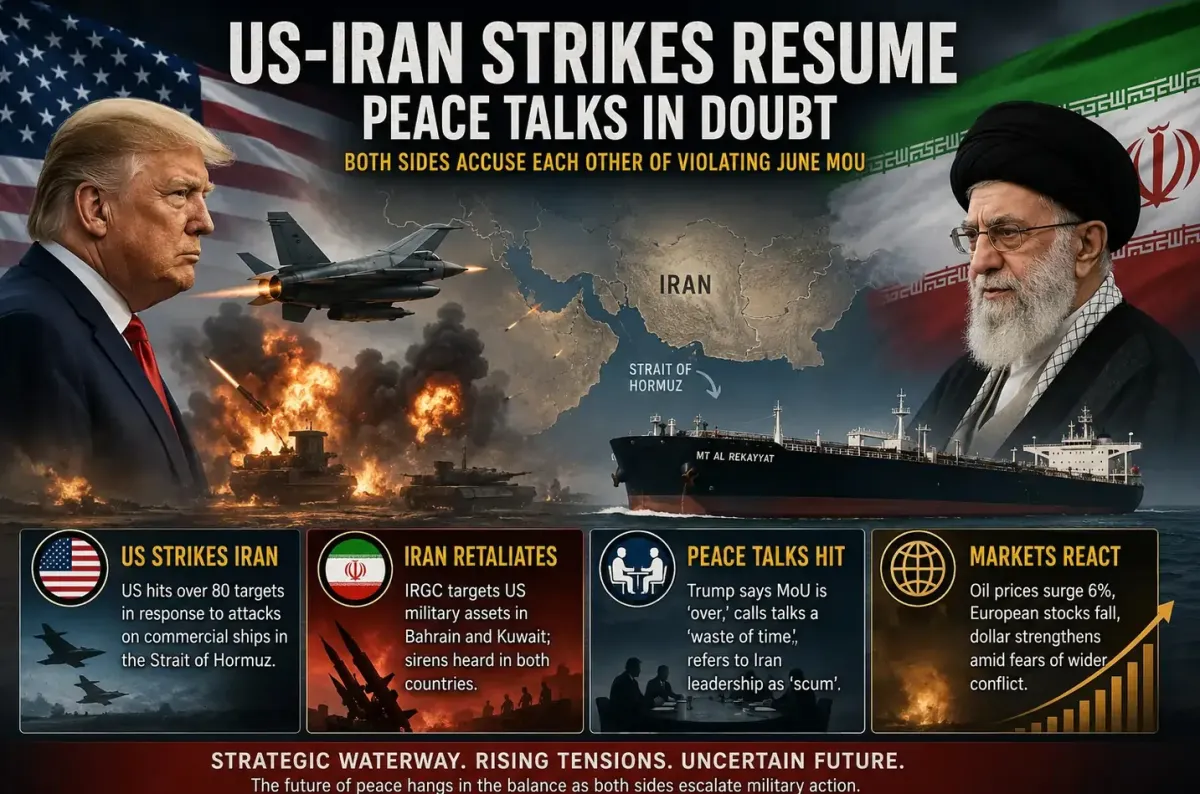
The United States launched strikes on more than 80 targets across southern Iran early on Wednesday, saying the operation was a direct response to attacks on commercial vessels transiting the strategically important Strait of Hormuz. The latest escalation has renewed concerns of a broader conflict in the Middle East and cast uncertainty over ongoing diplomatic negotiations.
Trump Says Peace Agreement Is 'Over'
Speaking to reporters on the sidelines of the NATO summit in Ankara, US President Donald Trump suggested the June MoU had effectively collapsed.
"I think it's over."
While indicating that negotiators could continue discussions, Trump added that he believed further talks were "a waste of time" and referred to Iran's leadership as "scum". His remarks triggered volatility across global financial markets, with Brent crude rising around 6 percent to approximately $78 per barrel, while European equities declined and investors shifted towards safe-haven assets.
What Triggered the Latest Military Action?
According to the US Central Command (CENTCOM), Iran targeted three commercial tankers transiting the Strait of Hormuz, including the Marshall Islands-flagged M/T Al Rekayyat, the Saudi Arabia-flagged M/T Wedyan, and the Liberian-flagged M/T Cyprus Prosperity.
Washington said its military response targeted Iranian air defence systems, command and control infrastructure, coastal radar installations, anti-ship missile capabilities and more than 60 Islamic Revolutionary Guard Corps (IRGC) boats operating near the strategic waterway. The US also revoked a sanctions waiver that had allowed certain Iranian oil exports under the June agreement.
Iran, however, disputed the US account. Officials said the vessels had entered an area where Iranian forces were conducting mine-clearing operations and ignored warnings to alter course.
"There is a possibility that these ships are headed in directions where Iranian teams in that area are clearing mines, and the ships' movement might have threatened those teams," Tehran-based analyst Hossein Royvaran told the media.
Areas Targeted in Iran
Iranian media reported explosions in the southern port city of Sirik, while strikes were also reported on Qeshm Island, near Bandar Abbas and at two military bases in Bushehr province.
Authorities said several people were injured by shrapnel in Sirik, although no fatalities were immediately reported. Iranian officials also confirmed damage at military facilities in Dashti county and near Chogadak in Bushehr province.
Iran Responds with Retaliatory Strikes
The Islamic Revolutionary Guard Corps (IRGC) announced retaliatory attacks targeting US military installations in Bahrain and Kuwait. Air raid sirens were reported in both countries, while Iran claimed it had struck multiple American military facilities and shot down an MQ-9 drone.
Iran's Ministry of Foreign Affairs condemned the US operation as a violation of both the United Nations Charter and the June memorandum.
"The terrorist US military... committed military aggression against several monitoring and surveillance centres on the southern coasts of Iran."
The ministry added that Iran's armed forces "will not hesitate in defending Iran's territorial integrity, national sovereignty, and national security".
Peace Talks Face Uncertain Future
The latest exchange of strikes has placed the 60-day negotiation framework agreed in June under significant pressure. Wednesday's attacks marked the third occasion on which the United States has carried out major military operations while negotiations were still ongoing, according to Iranian officials.
Although Washington has indicated further military action remains possible if attacks on international shipping continue, analysts believe neither side has entirely abandoned diplomacy.
Some observers argue the latest military operations remain calibrated rather than designed to trigger full-scale war, leaving open the possibility that negotiations could eventually resume despite the current escalation.
Regional and International Reactions
Several Gulf countries, including Kuwait, Bahrain, Qatar, Oman and the United Arab Emirates, condemned the Iranian attacks on military facilities and commercial shipping, describing them as violations of international law and regional sovereignty.
NATO Secretary-General Mark Rutte defended the US response, stating it was warranted following attacks on commercial vessels, while regional governments renewed calls for restraint and a return to diplomacy.
Why the Strait of Hormuz Matters
The Strait of Hormuz remains one of the world's most critical maritime trade routes, handling a significant share of global oil exports. Any disruption to shipping through the narrow waterway has immediate consequences for global energy markets, shipping costs and inflation.
With both Washington and Tehran accusing each other of violating the June agreement, the future of the peace process now depends on whether diplomacy can regain momentum before military escalation overtakes negotiations completely.