
Business
India's Clean Energy Shift Moves From Capacity Race to System Transformation
By MILLENNIUM NEWSROOM Desk · Published: Sep 22, 2026 07:24 PM · Updated: Sep 22, 2026 08:56 PM
5 min read
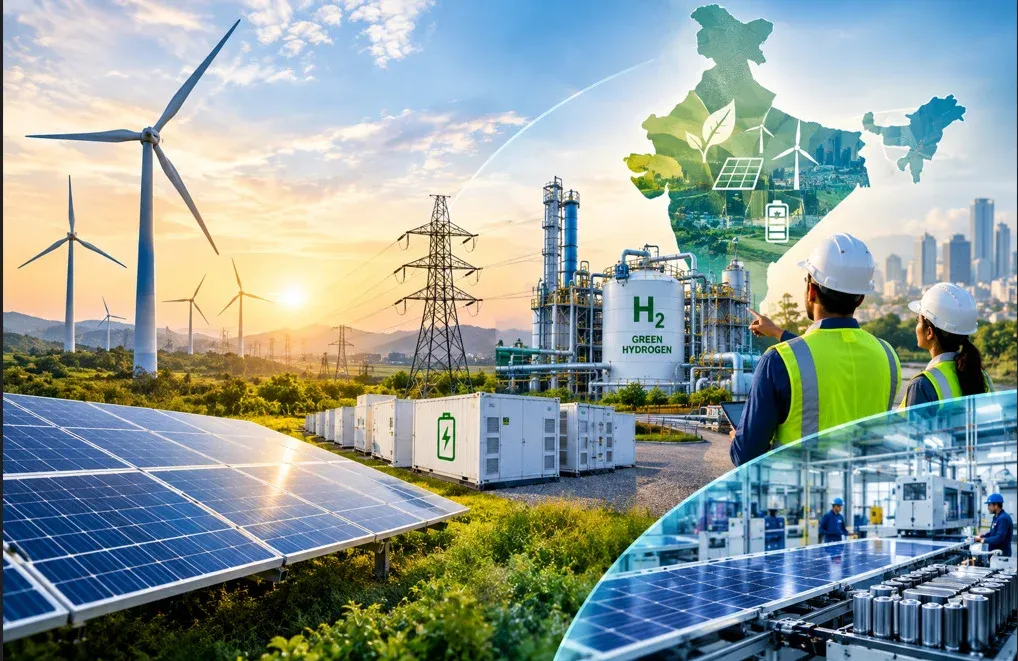
India's clean energy transition is entering a decisive new phase, one that is less about how much renewable capacity the country can build, and more about whether its grids, finances and industries can keep pace with that growth. As solar and wind installations accelerate across the country, industry experts say the real test now lies in scaling the harder segments of the energy transition, from green hydrogen to grid-scale storage, while ensuring the shift creates jobs and protects livelihoods in coal-dependent regions.
According to Rahul Das, AVP at Oorjan Cleantech, the transition is currently being driven by three interconnected forces, renewable power expansion, electrification, and the rise of clean-energy manufacturing. Solar, in particular, has emerged as the single biggest growth engine in India's energy mix. With electricity demand projected to grow at around 6.4% annually through 2030, solar photovoltaic capacity is expected to expand at nearly 24% a year, meeting roughly half of the country's additional electricity demand over the period.
This surge is being matched by capital flows. In 2024, close to 83% of India's power-sector investment was directed into clean energy, a signal that the energy transition has moved well beyond a policy commitment and into the realm of mainstream economic activity. Foreign direct investment into the sector has also been on the rise, reinforcing India's position as one of the world's most closely watched renewable energy markets.
Also Read:
India's Circular Economy Is Turning Industrial Waste Into Its Next Big Business Opportunity
Jobs, Manufacturing and the Shift Away From Assembly
The renewable energy growth in India is not confined to power generation alone; it is reshaping the country's employment landscape and industrial base. Demand is rising not just for engineers and technology specialists, but for EPC professionals, electricians, technicians, manufacturing workers, data analysts and grid-management experts. Globally, solar PV has already become the largest single contributor to new electricity-sector jobs, and India's storage and EV segments are expected to follow a similar trajectory.
On the manufacturing side, production-linked incentive schemes and broader industrial policy are nudging India away from being a pure deployment market, one that imports components and simply installs them, toward becoming a genuine manufacturing base for solar modules, batteries and other clean-energy hardware.
"The opportunity is to build deeper supply chains rather than simply assemble imported components. India has made meaningful progress on domestic manufacturing, but this should not be confused with complete supply-chain independence. The objective should be strategic diversification and competitive domestic manufacturing, rather than trying to produce every component domestically regardless of cost."
said Rahul Das, AVP, Oorjan Cleantech.
That caution is well-founded. Despite growing local production of modules and batteries, India remains dependent on imported machinery, critical minerals, wafers, cells and specialised chemicals. China continues to dominate the broader global supply chain, even as projections suggest India's share of global solar PV production could rise substantially by 2035.
The Harder Frontier for Hydrogen, Storage and Heavy Industry
While solar and wind have matured into commercially scalable technologies, the next phase of India's clean energy transition involves segments that are considerably harder to crack. Green hydrogen, long-duration energy storage, green steel, low-carbon cement and broader industrial decarbonisation remain in early, pilot-stage development. The obstacles here are not primarily technological; they stem from high upfront capital requirements, uncertain demand, missing infrastructure and the absence of mature markets operating at scale.
Green hydrogen illustrates the challenge well. It requires competitively priced renewable electricity, electrolysers, storage and transportation infrastructure, along with reliable buyers. India's National Green Hydrogen Mission has helped launch pilot projects in steel, mobility and shipping, but these now need to graduate into bankable, commercial-scale ventures. Energy storage carries similar urgency, since a grid increasingly dependent on solar and wind needs flexibility to manage fluctuations in generation.
The stakes extend well beyond the power sector. Steel, cement, fertilisers, chemicals and refining together form a substantial share of India's industrial economy. Decarbonising these sectors while preserving their global competitiveness could protect export markets and reduce future exposure to both imported fuel costs and emerging carbon-related trade barriers.
Also Read:
E20 Petrol at ₹102.12: Why India's Ethanol Gains Are Not Directly Reducing Pump Prices
Grids, Financing and the Digital Layer
Two structural constraints stand out as India works to sustain its pace of expansion, namely financing and grid infrastructure. While India's renewable financing costs remain competitive relative to other emerging economies, they are still markedly higher than in advanced economies, with the cost of capital for grid-scale renewable projects estimated at around 80% higher. Transmission bottlenecks compound the problem, with roughly 60 GW of renewable capacity reportedly held back by inadequate transmission infrastructure, alongside continuing challenges around land acquisition and permitting.
Digital technologies are increasingly being woven into this picture as India's grid absorbs more variable renewable energy, projected to account for around 24% of electricity generation by 2030. AI and data analytics are being used to forecast generation and demand and optimise battery dispatch, while IoT-enabled sensors across solar plants, wind turbines and substations are improving real-time visibility for utilities. These tools are delivering gains in predictive maintenance, fault detection and asset utilisation, but they also introduce new cybersecurity exposure as operational technology, cloud platforms and utility networks become more interconnected.
Also Read:
Former Finance Journalist Suyash Maheshwari Builds Editorial Infrastructure for Professional Services Firms Through FinBean Media
A People-Centric Path Forward
Perhaps the most understated challenge is the human one. Coal mining, transportation, power generation and the local economies built around them cannot be replaced overnight, and any credible transition strategy must include reskilling, new industrial investment and alternative employment opportunities in these regions before existing livelihoods are disrupted.
"India therefore needs a transition strategy that includes reskilling, new industrial investment, infrastructure development and alternative employment opportunities in coal-dependent districts," Das noted. "The objective should be to create new economic activity before existing livelihoods are significantly disrupted."
Looking ahead, experts argue that the next five to ten years should focus on faster investment in transmission and storage, cheaper and more predictable financing through blended finance and green bonds, globally competitive domestic supply chains, and clearer long-term markets for hard-to-abate sectors such as steel and cement. With clean energy already accounting for the majority of India's power-sector investment in 2024, the transition is increasingly being recognised not merely as a climate policy agenda, but as a full-scale economic and industrial transformation.