
Business
India's Circular Economy Is Turning Industrial Waste Into Its Next Big Business Opportunity
By MILLENNIUM NEWSROOM Desk · Published: Sep 18, 2026 07:43 PM
5 min read
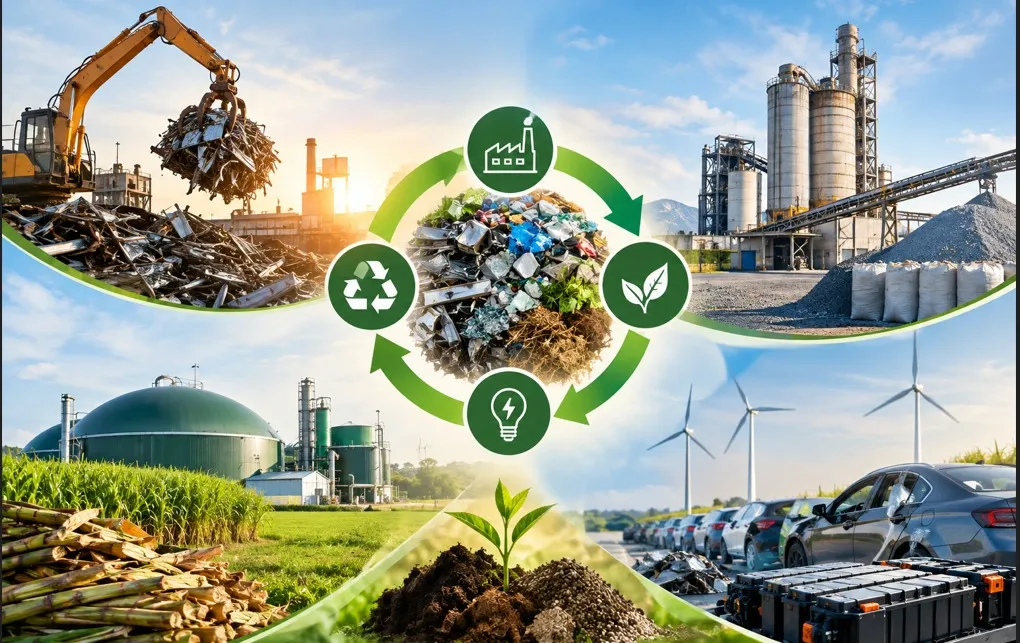
For decades, Indian industries treated waste as an afterthought, something to dump, burn or bury once the real business of manufacturing was done. That mindset is now cracking. Across steel, cement, automobiles, batteries and bioenergy, a quieter but far-reaching shift is underway, one where waste is being re-engineered into raw material, revenue and even climate value. This is the essence of India's emerging circular economy, and industry insiders say it is gathering pace faster than most people realise, even as structural bottlenecks threaten to slow it down.
Where the momentum is real
The clearest gains are visible in sectors where waste already carries obvious economic value and where regulation is nudging the market in the same direction. Steel and metals are being transformed by scrap-based production and electric-arc-furnace capacity, as scrap increasingly comes to be viewed as a strategic raw material rather than industrial leftover. Cement is another standout: fly ash, slag, gypsum and alternative fuels are steadily replacing virgin inputs in clinker production, with roughly a quarter of India's fly ash output already absorbed by cement makers, leaving considerable headroom for more.
Also Read:
E20 Petrol at ₹102.12: Why India's Ethanol Gains Are Not Directly Reducing Pump Prices
The automobile sector tells a similar story. End-of-life vehicles, once destined for scrapyards, are increasingly being viewed as "urban mines" containing steel, aluminium, copper, glass and batteries worth recovering formally rather than through informal dismantling. Lithium-ion batteries and e-waste follow the same logic, with the added urgency of reducing India's dependence on imported critical minerals such as lithium, cobalt and nickel.
Perhaps the most striking transformation, though, is unfolding in the sugar and ethanol belt.
Ethanol: the unlikely face of India's circular bioeconomy
India's ethanol-blending programme has quietly become one of the country's most visible proofs that policy can create a circular market almost from scratch. Ethanol blending in petrol rose to around 20 percent in 2025, up from barely 1.5 percent in 2014, a jump that has reshaped the relationship between farmers, sugar mills and energy companies.
But the real opportunity, experts argue, lies beyond the fuel pump. A modern integrated sugar-distillery complex can, in principle, turn a single tonne of sugarcane into sugar, ethanol, electricity, biogas, compressed biogas (CBG), organic fertiliser and even captured CO₂, with each byproduct feeding a different revenue stream instead of ending up as effluent. Bagasse generates power through cogeneration, press mud becomes compost or CBG feedstock, and spent wash is treated to recover biogas rather than pollute waterways. Early movers are already testing this model at scale. A cooperative sugar-mill project in Maharashtra has combined a CBG plant with a potash-granule facility as an explicit circular-economy showcase, while a joint venture between a public energy major and a bioenergy firm has announced plans for multiple CBG plants running on agricultural residue and distillery waste.
Yashodhan Ramteke, CEO of Ecoguard Global, who has worked closely on India's material-recovery and vehicle-scrapping ecosystem, describes the shift in industrial thinking this way:
"The common business model across all these sectors is moving from 'How do I dispose of this waste?' to 'What resource is contained in this waste, and who will pay for it?' That is a fundamental change in industrial thinking."
This reframing, from viewing waste as a liability to treating it as a balance-sheet item, is what is quietly driving industrial symbiosis clusters, where one factory's slag becomes another's raw material, and one plant's excess heat powers a neighbouring facility.
Also Read:
OneSource Specialty Pharma Reports 37% Revenue Growth, 39% EBITDA Rise in Q1 FY27
The barriers that still hold India back
Yet for all this progress, scaling remains difficult, and the obstacles are less about technology than about economics and institutions. Feedstock aggregation is one of the biggest challenges. Unlike a standard commodity, waste varies constantly in quantity, quality, moisture and seasonality, making it hard for recyclers or bioenergy plants to guarantee a steady supply. Logistics compound the problem, since waste typically has a poor value-to-volume ratio, meaning transportation costs alone can wipe out project economics unless preprocessing, such as sorting, drying and baling, happens close to the source.
Financing is another persistent hurdle. Banks are comfortable underwriting conventional factories but far less so when a project's viability depends simultaneously on waste supply, offtake contracts, extended producer responsibility (EPR) revenue and carbon-credit pricing. Add to this the absence of recognised quality standards for recycled steel, plastic or organic fertiliser, which pushes buyers back toward virgin material, and a regulatory landscape where a single circular project can fall under multiple ministries, and it becomes clear why many promising pilots struggle to graduate into full-scale infrastructure.
Ramteke argues that the missing piece is not more individual projects but the ecosystem to support them:
"Today we have many successful individual projects. The next step is creating an ecosystem where thousands of projects can be developed, financed, monitored and transacted. That means recognised standards for secondary materials, stronger EPR verification and genuine industrial symbiosis clusters."
From projects to infrastructure
The path forward, industry voices suggest, runs through five priorities. These include turning recycled materials into mainstream, certifiable commodities; strengthening EPR frameworks so they deliver verified physical recovery rather than certificate trading; building industrial symbiosis clusters where waste streams are shared across companies; linking circular projects with climate finance through robust monitoring, reporting and verification; and investing in digital infrastructure, such as material registries, traceability platforms and marketplaces, that can do for circular materials what stock exchanges did for capital.
Also Read:
Makhana Dialogue Calls for Stronger Market Ecosystem to Boost India's Superfood Exports
India's circular economy, in short, is no longer a niche sustainability experiment. It is becoming an industrial strategy with real balance-sheet consequences, spanning everything from steel mills to sugarcane fields. Whether it becomes truly mainstream, however, will depend on how quickly the country can move from isolated success stories to the standardised, financeable infrastructure that lets circularity scale nationwide.