
Technology
Thirsty Giants: The Hidden Environmental Impact of India’s Data Centre Boom
By MILLENNIUM NEWSROOM Desk · Published: Oct 19, 2026 06:32 PM
4 min read
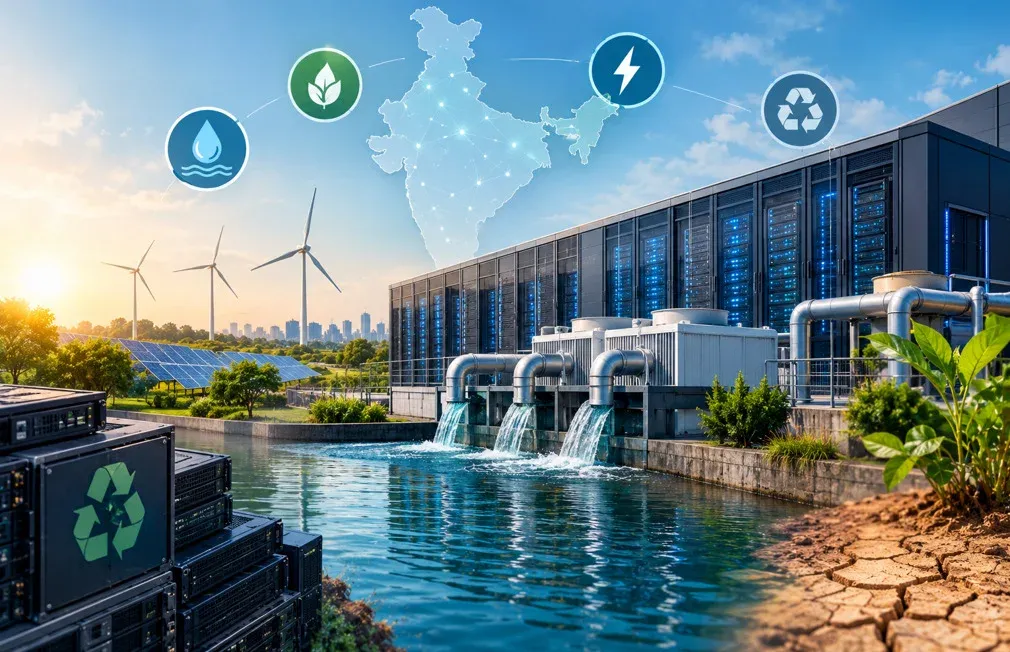
India’s data centres can consume between one and five million gallons of freshwater every single day, roughly what a town of lakhs of residents uses at home. In a country where drinking water and farm irrigation already compete for the same shrinking aquifers, that figure has turned the data centre environmental impact into one of the most urgent infrastructure questions of the decade.
The industry’s rise is not in doubt. Data centres are critical digital infrastructure, drawing billions in foreign direct investment, powering artificial intelligence and cloud computing, and creating skilled jobs. Keeping data on Indian soil also strengthens national data sovereignty. The question is what they will cost the land and water around them.
Also Read:
Invisible Grid: How AI Became Human Civilisation’s New Infrastructure
Why water-stressed regions face the greatest risk
The sharpest threat is water. Hyperscale facilities that rely on traditional evaporative cooling towers need millions of litres of freshwater daily. In water-stressed regions, that demand competes directly with municipal drinking supplies and farming while pulling down underground aquifers.
Withdrawal is only half the problem. Cooling systems also discharge hot, chemically treated “blowdown” water, which can cause thermal pollution, alter aquatic ecosystems and degrade soil if released untreated.
“When developers draw heavily from local aquifers or municipal grids, they directly compete with local communities, agriculture and drinking supplies. In drought-prone areas, this accelerates groundwater depletion, lowers the water table and exacerbates scarcity, turning an operational resource demand into a permanent environmental threat,” said Dinesh Jotwani, Advocate, Supreme Court of India and Technology Attorney.
Beyond water: air, energy and e-waste
Carbon-intensive grid electricity adds to greenhouse gas emissions, while large diesel generator farms release particulate matter (PM2.5) and nitrogen oxides during outages, worsening local air quality.
Hardware compounds the problem. Rapid server refresh cycles produce tons of hazardous e-waste, and toxic battery runoff can threaten groundwater unless certified recyclers handle it.
Also Read:
ADAS in India Helps Drivers Avoid Crashes, Not Just Survive Them
What the rules already require
India has no standalone “Data Centre Environmental Clearance”. Developers instead face the Environmental Impact Assessment (EIA) Notification, with thresholds based on building size, energy use, water draw and emissions. Compliance also covers zoning, diesel generator emission standards, the E-Waste (Management) Rules, 2022, the Battery Waste Management Rules, 2022, and the Hazardous and Other Wastes Rules, 2016.
A Central Ground Water Authority No Objection Certificate is mandatory for groundwater extraction, and the Data Centre Evaluation Framework (2026) requires power sources, including biofuels and green hydrogen, to be managed and reported.
Mistakes to avoid, alternatives to adopt
Developers can avoid the worst outcomes by sidestepping four common errors:
- Fossil dependence: relying on fossil grids and diesel backups.
- Thirsty cooling: open-loop evaporative cooling that drains municipal or groundwater.
- Poor siting: building in ecologically sensitive or flood-prone zones without a full impact assessment.
- Informal e-waste: non-certified disposal of retired servers and hazardous batteries.
Practical alternatives already exist. Direct-to-chip liquid cooling uses closed-loop systems that lower Power Usage Effectiveness (PUE) and sharply cut freshwater consumption. Battery Energy Storage Systems (BESS) or green hydrogen can replace diesel generators. Power Purchase Agreements for 100 per cent renewable energy, sourced from wind, solar or hybrid microgrids through Green Energy Open Access, can clean up the electricity supply.
Policy levers for a greener build-out
Expanding the Green Energy Open Access Rules would require facilities to source power from captive solar, wind or storage. Closed-loop cooling could be enforced to lower Water Usage Effectiveness (WUE), and state subsidies tied to efficiency metrics such as PUE. Backup diesel generators could be phased out in favour of BESS or green hydrogen, removing a major source of local air pollution.
A sustainable data centre future
If sustainability becomes the central driver, expansion could shift from coastal cities to renewable-rich corridors such as Rajasthan and Gujarat, and to Tier-2 regions with local solar and wind microgrids. Round-the-clock clean energy contracts, on-site BESS and green hydrogen would replace grid dependence and diesel backup.
“If environmental sustainability becomes the central driver, India’s data centre industry will undergo a structural shift. Facilities will universally adopt zero-water, direct-to-chip liquid cooling and immersion systems, dropping average PUE below 1.2,” said Dinesh Jotwani, Advocate, Supreme Court of India and Technology Attorney.
Policy would shift with it, from production-linked incentives to milestone-linked growth, so that rewards follow measurable environmental results rather than capacity alone. Approvals and subsidies could hinge on verified ESG performance, mandating zero freshwater draw and circular e-waste recycling.
Also Read:
India's EV Boom Is Changing How Cars Are Built, Charged and Fixed
India need not choose between digital ambition and environmental security. But the next wave of construction, from cooling technology to power source to site, will decide, for residents and investors alike, whether data centres strain water-stressed communities or become a model of sustainable data centres.