
Technology
ADAS in India Helps Drivers Avoid Crashes, Not Just Survive Them
By MILLENNIUM NEWSROOM Desk · Published: Oct 01, 2026 03:50 PM
5 min read
India's automotive industry is entering a new phase in how it thinks about protection on the road. As Advanced Driver Assistance Systems move into the mainstream, ADAS in India is pushing carmakers to ask a different question. Instead of only asking how to protect occupants during a crash, they now ask how to help drivers avoid one in the first place. The shift is gradual, but it is reshaping design priorities, engineering choices and the future of mobility.
From Passive Protection to Preventive Safety
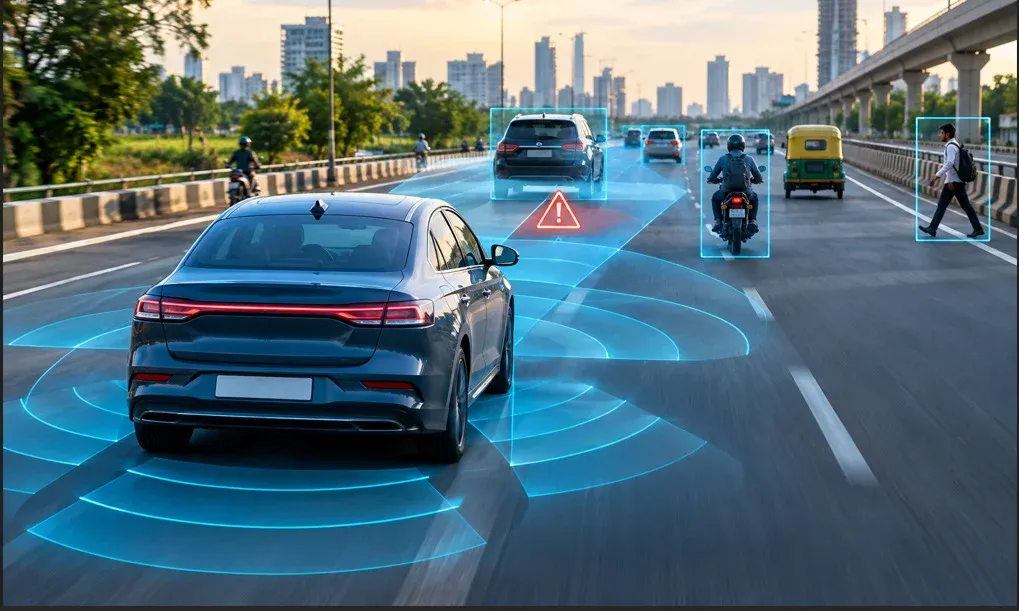
For years, vehicle safety in India has rested largely on passive measures, which protect occupants once an accident has already happened. ADAS adds a preventive layer. It uses sensing and real-time decision support to identify potential hazards and assist drivers before a situation becomes critical.
India's driving environment makes this far from simple. Conditions range from controlled expressways to congested city streets and poorly marked rural roads. Safety systems must therefore account for local traffic behaviour, road quality and the presence of vulnerable road users. As a result, automakers are placing greater emphasis on sensing accuracy, system reliability and performance across a wide variety of scenarios.
The Challenge of Unpredictable Roads
The biggest hurdle is the unpredictability of Indian roads. Systems built around clearly defined lanes and orderly traffic can struggle when lane markings fade, traffic patterns shift suddenly or two-wheelers weave through narrow gaps. Pedestrians, animals, roadside activity and uneven surfaces add further complexity.
Meeting this challenge calls for perception systems that do not depend on a single source of information. Sensor fusion, robust algorithms and extensive local testing are becoming central to the effort.
"One of the biggest challenges is the unpredictability of India's road environment. ADAS systems designed around clearly defined lanes and predictable traffic can face limitations when lane markings are faded, traffic patterns change rapidly or two-wheelers move through narrow gaps. The challenge is not simply adapting global technology, but ensuring that systems remain dependable under India's highly diverse real-world driving conditions."
— Pavan Puri, Founder, Greencore Electronics Pvt. Ltd.
What ADAS Can, and Cannot, Do for Road Safety
ADAS can help address several factors linked to road accidents: delayed driver reactions, distraction, unintended lane departures and limited awareness of surrounding vehicles. Features such as forward collision warning, automatic emergency braking, lane-departure assistance and driver monitoring offer extra support when human response may be compromised.
The scale of the benefit, however, is not fixed. It depends on the specific system, the driving environment, how well the technology is integrated into the vehicle and how drivers use it. ADAS is best understood as an additional layer of safety, not a substitute for responsible driving. In India, its real potential will rest on how well systems are calibrated for local traffic and road conditions.
Also Read:
India's EV Boom Is Changing How Cars Are Built, Charged and Fixed
Taking ADAS Beyond Premium Cars
For ADAS to matter at scale, it must reach mass-market cars, and that raises the question of cost. The answer, according to the industry view reflected here, lies in balance. Safety benefits, system complexity and vehicle price all have to be weighed together.
Rather than launching every advanced function at once, automakers can prioritise features that address common driving risks and can be deployed efficiently across segments. Local sourcing, greater integration of electronic components, scalable architectures and software-based functionality can all help contain costs. India's large automotive market also creates room to build safety systems around practical, real-world use cases instead of copying premium-market specifications. The goal is meaningful driver assistance that is increasingly accessible, without compromising on reliability, performance or safety standards.
Real-World Data Is Shaping Localisation
Another important influence is the growing availability of real-world driving data. Controlled testing can confirm that a system performs as designed, but actual roads throw up situations that are hard to reproduce in a laboratory. Two-wheelers, informal lane behaviour, pedestrians, varied infrastructure and rapidly changing traffic patterns all test the limits of perception and decision-making software.
Analysing these scenarios helps engineers find gaps in perception, classification and decision-making. Over time, larger datasets support better calibration and localisation of ADAS functions.
"Controlled testing can validate system performance, but actual roads reveal situations that are difficult to reproduce consistently in laboratories. Analysing these scenarios can help engineers identify gaps in perception, classification and decision-making systems. The important shift is towards developing systems based not only on global assumptions, but also on evidence gathered from the environments and driving behaviours they are expected to encounter."
— Pavan Puri, Founder, Greencore Electronics Pvt. Ltd.
A Bridge to Autonomous Vehicles
Looking further ahead, ADAS is likely to remain a crucial bridge between conventional driving and autonomous vehicles. Higher levels of automation need capabilities such as environmental sensing, object recognition, driver monitoring, decision-making and vehicle control, and many of these are already being developed through today's driver-assistance functions.
Also Read:
How AI in Indian Defence Went From the Lab to the Battlefield
That progression will stay closely tied to safety validation, regulation, infrastructure and consumer understanding. Given how much India's driving environments vary, the transition may be gradual and application-specific. ADAS can serve as an intermediate layer, letting manufacturers introduce increasing levels of assistance while building the technological foundation for future automation.
The Road Ahead
The story of ADAS in India is not simply one of importing global technology. It is about adapting, testing and refining systems against the country's own roads and driving behaviour. Success will depend on dependable performance, sensible pricing and steady learning from real-world data. If those pieces fall into place, driver assistance could move from a premium feature to a practical, widely available layer of protection, and shift the national conversation on road safety from reacting to crashes to preventing them.