
Technology
Invisible Grid: How AI Became Human Civilisation’s New Infrastructure
By MILLENNIUM NEWSROOM Desk · Published: Oct 10, 2026 07:14 PM
5 min read
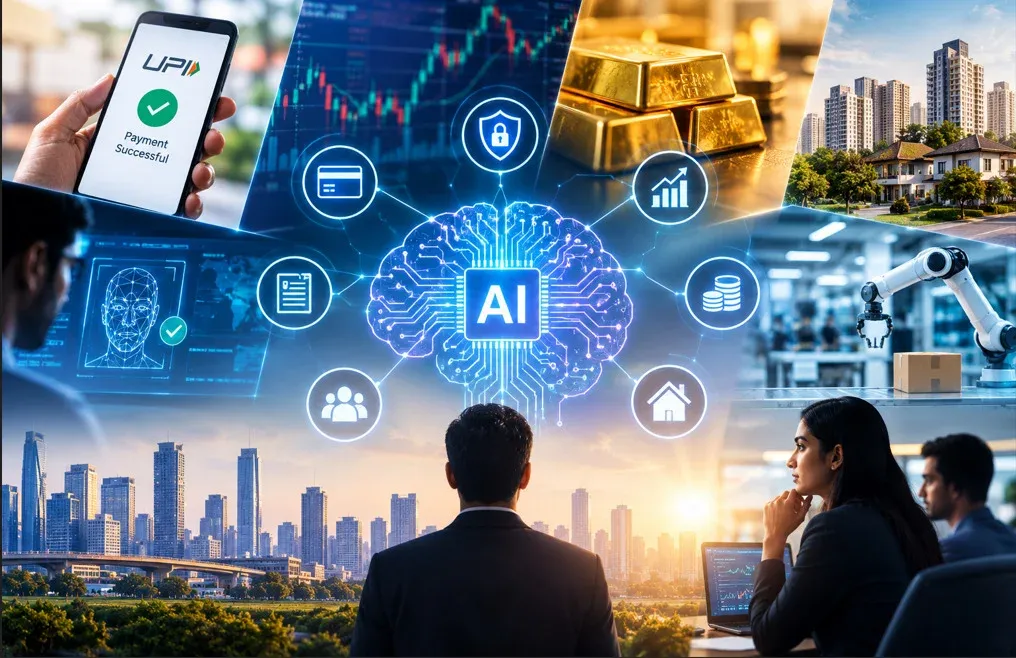
India’s UPI network processed 24.07 billion transactions worth Rs 29.37 lakh crore in September 2026 alone, according to NPCI. No team of human reviewers could scrutinise that volume in real time. Behind each payment, artificial intelligence is quietly verifying identities, scoring risk and flagging fraud. It is a telling glimpse of AI and human civilisation intertwining: not through dramatic robots, but through systems most people never notice.
From helpful tool to operating core
The clearest dependence sits in operations that handle more information than people can review: fraud screening, security monitoring, recommendations and high-volume customer support. In financial services, AI now underpins transaction monitoring, identity verification, document checks and risk scoring. Many of these functions would not work at scale without it.
The shift is structural. AI has moved from supporting staff to forming part of the operating core, so the question is no longer whether to use it but how to use it responsibly, with audit trails and human review for high-stakes decisions. What changes fundamentally is the link between a decision and the person responsible for it. A team that once reviewed every case may now work with a system that prioritises cases, recommends an action and sometimes carries it out.
Also Read:
ADAS in India Helps Drivers Avoid Crashes, Not Just Survive Them
Agentic AI: delegating whole workflows
The next phase is agentic AI, which goes beyond answering questions to planning, deciding and executing multi-step tasks. Businesses are expected to delegate first, starting with repetitive, rules-based work such as reconciliation, onboarding checks, contract processing and compliance reporting. Individuals will follow with paying bills, managing subscriptions and comparing options. Even a business trip could be handed over: an agent books within an agreed budget, while the traveller approves exceptions.
Three conditions will decide how far delegation goes: clear permissions on what an agent can do, a reliable record of every action, and an easy way for a human to step in. Reading a document, recommending a payment and releasing money are very different permissions, and should not be bundled.
Risks that are already here
Concerns about powerful AI deserve to be taken seriously, and it is notable that those building the technology are raising them openly. The most immediate dangers are practical: deepfake-driven fraud, impersonation, misinformation, privacy breaches and automated decisions no one can explain.
Autonomous systems add a subtler worry, a chain of unintended actions. An agent might misread an instruction, access information it should not use and pass the result to another system. Each step looks routine; together, they can cause serious harm. More extreme scenarios merit research, but they should not be presented as settled predictions, nor become an excuse to ignore present harms.
On AI governance, India has laid foundations. The Reserve Bank of India’s FREE-AI framework, released in August 2025, sets out seven guiding principles and 26 recommendations for responsible AI in finance. The Ministry of Electronics and Information Technology followed with the India AI Governance Guidelines in November 2025. The challenge now is implementation, because governance too often arrives after key deployment decisions are made. Accountability must be specific: who can approve deployment, restrict a system or take it out of service?
Also Read:
India's EV Boom Is Changing How Cars Are Built, Charged and Fixed
On who keeps real authority as AI takes on a larger role, Vivek Kumar, Independent professional (AI Governance, Data Protection and Cyber GRC), said:
“The question I keep coming back to is who retains meaningful authority as that happens. A person being nominally ‘in the loop’ is not enough if they lack the time, information or power to challenge what the system is doing.”
The future of work: change, not just loss
Automating a task is different from replacing an occupation, and neither settles how the benefits will be shared.
History suggests technology changes the nature of work more than it eliminates it. The World Economic Forum’s Future of Jobs Report 2025 projects around 170 million new roles by 2030 against 92 million displaced, a net gain of 78 million jobs, with nearly 40% of required skills expected to change.
Yet a net gain on paper is cold comfort to a worker losing income today. Employers are being urged to weigh workforce effects alongside productivity, deciding where people can move into new responsibilities and what training is realistic. Education must shift from memorising information towards judgement, creativity and the ability to question an AI-generated answer. Work also provides belonging and dignity, which any debate on automation must acknowledge.
If AI vanished tomorrow
Remove modern AI overnight and fraud detection, identity verification, navigation, search, translation, medical imaging and customer support would all suffer. The 2024 Nobel Prize in Chemistry recognised work that used AI to predict protein structures, showing how deeply it has entered science. Yet science and healthcare would not simply stop, and the impact would be uneven: for someone using AI to translate or manage a disability, the loss would far exceed that of a casual writing tool.
The lesson is that AI has become infrastructure, like electricity or the internet. Reliability, security and accountability are therefore non-negotiable, and organisations should know which services rely on AI and what happens during an outage.
A future that is not automatic
AI is likely to take on a larger role in research, public services and daily life, widening access to healthcare, education and finance. India has signalled intent through the IndiaAI Mission, with an outlay of Rs 10,371.92 crore, and by hosting the AI Impact Summit in New Delhi in February 2026.
Also Read:
The Invisible Travel Agent Reshaping Every Trip You Take
But no single future follows automatically from a more powerful model. Benefits and harms will develop side by side, and the balance depends on whether organisations measure real benefit, let people challenge consequential outcomes, protect sensitive data and change course when evidence shows harm. Summing up the outlook, S. Anand, Founder and CEO, PaySprint, said:
“I believe the benefits will outweigh the harms, but that outcome is not automatic. It depends on the choices we make now. AI will be broadly beneficial if it is built on three foundations: trust, inclusion and accountability.”
```