
Technology
How Drones Are Rewiring India’s Critical Infrastructure from Inspection Tools to Intelligence Layers
By MILLENNIUM NEWSROOM Desk · Published: Sep 13, 2026 12:32 PM
6 min read
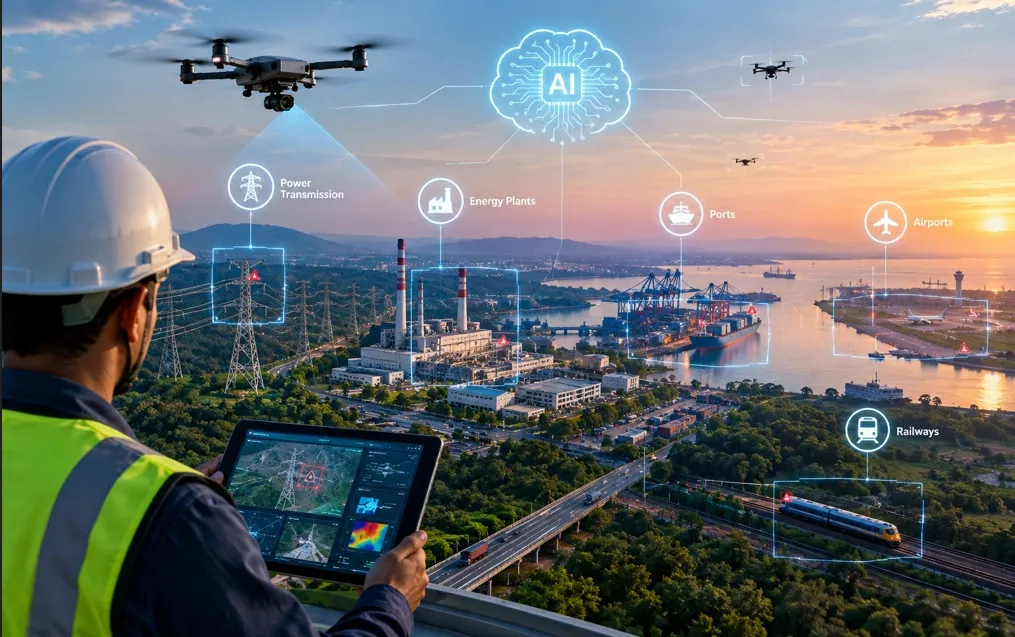
For years, drones in India were treated as a novelty for aerial photography and hobbyist flying. That framing no longer holds. Drone technology in India's critical infrastructure has quietly moved past the experimentation stage and into targeted, mission-specific deployment, with power transmission networks, energy plants, railways, ports, airports, pipelines and large industrial facilities all evaluating drones as a new layer of situational awareness. The bigger story, though, is not the number of drones taking flight. It is what happens to the data once they land, and whether India can build the trust, integration and business models needed to scale this shift nationally.
Where Adoption Is Moving Fastest
The clearest gains are showing up in exactly the areas where traditional inspection methods are the most expensive, slowest, or riskiest for personnel. Asset inspection, perimeter surveillance, topographical mapping, thermal inspection and monitoring of hard-to-access infrastructure are the applications seeing the fastest uptake, largely because they replace manual climbing, long shutdown windows, or exposure to hazardous conditions with a faster aerial alternative. But the more consequential shift is not the drone itself, it is what is layered on top of it. Rather than simply capturing thousands of images for a human to sift through later, AI is increasingly being used to flag anomalies directly, such as overheating equipment, structural deterioration, intrusions or unusual activity, cutting the time between detection and decision.
Also Read:
How AI in Indian Defence Went From the Lab to the Battlefield
That trajectory points toward a longer-term transition: from periodic, scheduled drone inspections toward continuous, intelligence-led monitoring, particularly once drones are networked with IoT sensors, command-and-control systems and digital twins of physical assets. In that model, a drone stops being a one-time inspection tool and becomes a recurring sensor feed into a much larger monitoring system.
The Real Bottleneck Isn't Hardware
If drone hardware were the constraint, this transition would already be well underway. It isn't hardware holding critical infrastructure operators back, it is integration, trust and operational maturity. Drones cannot function as standalone devices in environments like ports, power grids or airports. They need to talk to existing CCTV networks, radar, IoT sensors, access-control systems, security operations centres and command-and-control platforms already in place, and that raises hard questions around interoperability, cybersecurity and data sovereignty.
Regulatory friction compounds the problem. Operating drones beyond visual line of sight, enabling autonomous flight, managing airspace, and flying near sensitive infrastructure all remain areas of active regulatory evolution rather than settled practice. There is also a less obvious risk hiding inside the opportunity itself: every connected drone effectively becomes another endpoint in an infrastructure operator's technology ecosystem, which means cybersecurity has to be built in rather than added later.
"Critical infrastructure cannot treat drones as standalone devices. They need to integrate with existing CCTV, radar, IoT sensors, access-control systems, SOCs and command-and-control platforms. The real challenge, therefore, is creating a trusted drone-to-data-to-decision architecture rather than simply increasing the number of drones deployed", Ashish Kumar, Managing Director, OptiValue Tek
That framing reorients the entire adoption conversation. The goal isn't more drones in the sky. It's a dependable pipeline running from the drone, through the data it captures, to a decision an operator can actually act on, and every weak link in that chain, whether it is connectivity, analytics or cybersecurity, undermines the value of the deployment.
What It Actually Costs to Go Operational
Investment requirements vary sharply depending on the mission. A basic surveillance or inspection operation may need little more than the drone itself and trained operators, while a critical-infrastructure-grade deployment demands considerably more: thermal or LiDAR payloads, AI analytics, secure communication systems, edge computing, specialised software, and ongoing maintenance and cybersecurity capacity.
The commercial case strengthens considerably once a single drone platform is used across multiple functions rather than one. The same aircraft that inspects an asset can also support perimeter surveillance, emergency response, mapping and predictive maintenance, spreading the cost of the underlying technology stack across several use cases instead of one. That reframes the return-on-investment question entirely: rather than asking how much a drone costs, infrastructure operators are better served asking how much risk, downtime, inspection cost and manpower the system can eliminate. For large infrastructure operators, this shift in framing is what makes fleet-based deployments and Drone-as-a-Service models increasingly attractive over buying and operating hardware independently.
Also Read:
Beyond Compliance: How Businesses Can Build Fire-Safe Infrastructure for Long-Term Operational Resilience
Where Government Support Falls Short
Government initiatives have played a genuine role in building India's drone ecosystem, but critical infrastructure has fundamentally different needs from conventional commercial drone use. The cost of a deployment is never limited to the aircraft alone. Organisations also need sensors, AI platforms, secure connectivity, skilled personnel, data infrastructure, maintenance and cybersecurity, and financing mechanisms need to support that entire technology stack rather than focusing primarily on hardware acquisition.
There is meaningful room for more public-private models that let infrastructure operators access drone capabilities as a service rather than committing to a large upfront investment, an approach that could be particularly useful for state utilities, municipal infrastructure bodies and smaller operators who cannot justify owning a full technology stack outright.
Why "As-a-Service" Models Are Likely to Win
For critical infrastructure specifically, Drone-as-a-Service and integrated technology partnerships are positioned to prove more sustainable than widespread individual ownership. A power utility, port or industrial facility does not necessarily need to own every layer of the technology stack; it can instead contract specialised providers for drone operations, AI-based analytics, maintenance and threat monitoring, paying for outcomes rather than owning infrastructure that ages and depreciates.
The longer-term model is expected to be ecosystem-driven rather than vendor-driven, bringing drone manufacturers, AI companies, cybersecurity firms, digital-twin providers and infrastructure operators into a shared structure. Built correctly, this kind of integrated platform means a drone is no longer simply capturing an image. It is feeding intelligence directly into an organisation's existing command-and-control environment and helping generate an actionable response.
Also Read:
The Future of GCCs in an Agentic AI World
From Inspection Tool to National Security Layer
Looking five to ten years ahead, the opportunity is framed less around drone adoption for its own sake and more around a shift in what drones are for altogether: moving from inspection tools to autonomous infrastructure intelligence systems. That could mean drones routinely monitoring power corridors, ports, pipelines, rail networks and airports, with AI identifying anomalies before they escalate into operational failures or security incidents.
The convergence of drones, AI, digital twins, IoT, edge computing and cybersecurity is expected to matter more than any single technology in isolation. A digital twin can offer a virtual representation of a physical asset, while continuous drone data updates that twin with real-world conditions, closing the gap between what an operator assumes about an asset and what is actually happening to it in the field.
"This creates the possibility of a predictive and resilient critical infrastructure ecosystem, one that can identify a structural weakness, detect a security threat or anticipate an equipment failure before it creates a larger disruption. For India, the long-term opportunity is therefore much bigger than building a domestic drone industry", Ashish Kumar, Managing Director, OptiValue Tek
That last point is worth sitting with. The conversation around drone adoption in Indian infrastructure often gets reduced to manufacturing targets and fleet numbers, but the underlying ambition is broader: building an intelligent aerial layer that supports infrastructure protection, operational resilience and national security all at once. Achieving that will depend less on how many drones India puts into the air and more on whether the country can solve the harder problems of integration, cybersecurity, financing and trust that determine whether AI-powered drone monitoring actually translates into safer, more resilient infrastructure, and whether Drone-as-a-Service models can bring that capability within reach of operators who cannot build it alone.