
Politics
Can CJP Make It Two in a Row?
By MILLENNIUM NEWSROOM Desk · Published: Sep 28, 2026 07:48 PM
4 min read
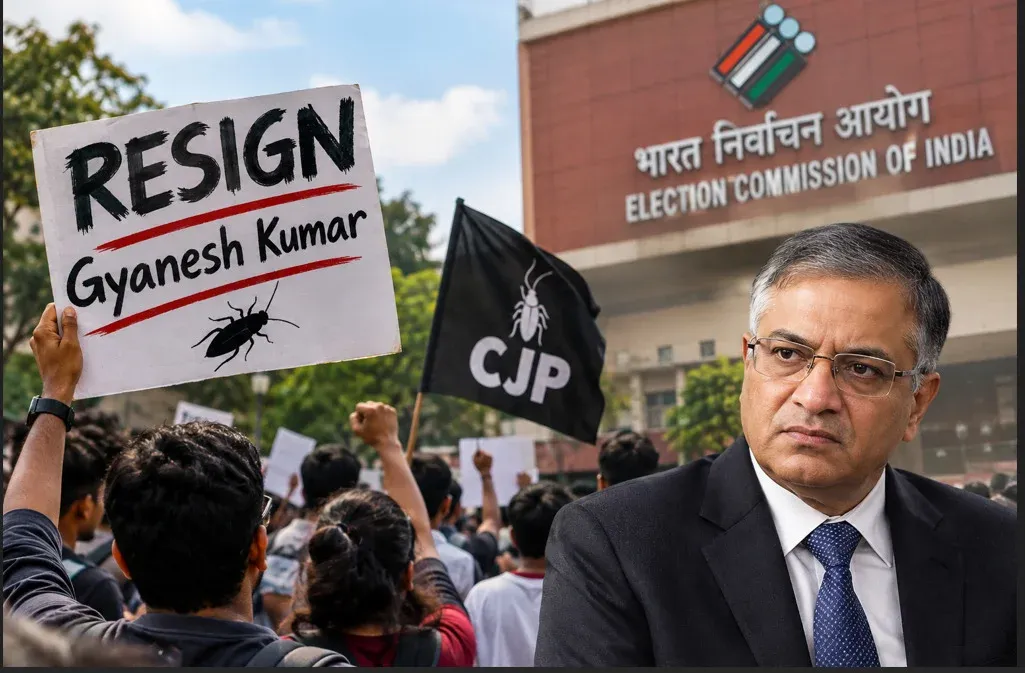
Days before its planned nationwide protest on October 2, the Cockroach Janta Party (CJP) is facing police action, denied permissions and a hardening standoff over its demand that Chief Election Commissioner Gyanesh Kumar resign.
On Sunday, Assam Police detained CJP co-convenor Ashutosh Ranka in Guwahati, shortly before the group's first regional volunteers' meeting. He was released and told reporters on Monday that the outfit would not step back until Kumar quits. The Mumbai Police have reportedly refused permission for the October 2 demonstration in the city, and CJP founder Abhijeet Dipke has spoken of a "Jail Bharo Andolan" if protest rights are denied. In Delhi, AISA president Neha Bora, who was detained at Jantar Mantar last Friday, went to the Parliament Street police station on Monday. She was accompanied by senior advocate Prashant Bhushan and others, to submit an intimation for an October 2 protest at the same site.
The confrontation began on September 24, when CJP gave Kumar 48 hours to resign. It cited the alleged exclusion of over 13 crore names from draft electoral rolls during the Special Intensive Revision (SIR). Its case gained weight from a media report saying two election commissioners had formally objected 14 times in ten months to SIR-related decisions. The ultimatum has expired, and CJP says the next move is its own.
Gyanu Must Go! pic.twitter.com/pZc7CCjd9P
— Abhijeet Dipke (@abhijeet_dipke) September 28, 2026
The precedent
Those following the movement keep returning to July 25. That day, Education Minister Dharmendra Pradhan resigned over the NEET-UG paper leak, after a 36-day agitation and a sit-in at Jantar Mantar that began on June 20. The protests included a Parliament march on July 20 that ended in lathi-charge and tear gas. Government talks with CJP leaders followed, and Pradhan's resignation came within a day, after which CJP called off its agitation. Resignations, the government's critics had said, do not happen under this dispensation. This one did.
Also Read:
Broken Toilets, Unsafe Water and Crumbling Classrooms: Questions Mount Over India’s School Infrastructure
One political commentator who has followed the movement closely reads the Pradhan episode as a template, and he argues it changed more than one portfolio. The resignation, he says, showed that accountability can reach the top, and that the NTA has since been reformed. He also argues that it gave young people a reason to believe agitation can work. In his words:
"Pradhan episode has given birth to a new-found voice among the youth, the GenZ, and instilled confidence that movement may lead to some results, in an atmosphere of despondency and hopelessness."
— Prof. Ujjwal Anu Chowdhury
What is different this time
The comparison is not exact, and the differences matter. Pradhan was a minister answerable to the Prime Minister. The CEC is a constitutional officer, and the opposition's attempt in April to move a removal motion against Kumar was rejected by the Rajya Sabha Chairman and the Lok Sabha Speaker. The NEET agitation also had a concrete, widely felt grievance, a leaked exam. The voter-roll issue is more technical, and CJP must convince young people that it affects them just as directly.
The commentator sees that as the real task of the October 2 call. He describes the NEET campaign as a movement that started with an education issue and has moved onto the mainstream political stage. He also points to the reach of the group's Instagram following, which is about 26 million. In his view, an issue becomes a movement in stages:
"Awareness is the first stepping stone for any activism. Truth begins with a minority, and if it is powerful, it catches up with the majority."
— Prof. Ujjwal Anu Chowdhury
He also expects the opposition and the Left to lend support, though without formally merging with CJP. That is significant in itself, since the students of AISA have already been on the streets alongside civil society figures. Detentions in Delhi and Guwahati, and the refusal of permission in Mumbai, have so far tended to bring a movement more attention rather than less.
Also Read:
NEET Paper Leak to CJP Protests: Why India Needs Lasting Exam Reforms Beyond Crisis Management
Watching October 2
None of this guarantees an outcome. Governments can wait out an agitation, and a constitutional post is harder to vacate than a ministry. But the sequence so far has a familiar shape: an ultimatum, police action, permissions refused, and volunteers who keep turning up anyway. In July, that sequence ended with the government yielding on the movement's central demand.
Whether Gyanesh Kumar's position proves as movable as Pradhan's will be clearer after Gandhi Jayanti. Given how the last campaign ended, it would be unwise to rule out another surprise.
(AI Generated Image)
Also Read: