
Opinion
How Women Empowerment Is Driven by Education in India: Progress, Challenges and the Road Ahead
By MILLENNIUM NEWSROOM Desk · Published: Jul 04, 2026 03:15 AM
10 min read
Savitribai Phule
"Awake, arise and educate. Smash traditions – liberate!"
B.R. Ambedkar
"I measure the progress of a community by the degree of progress which women have achieved."
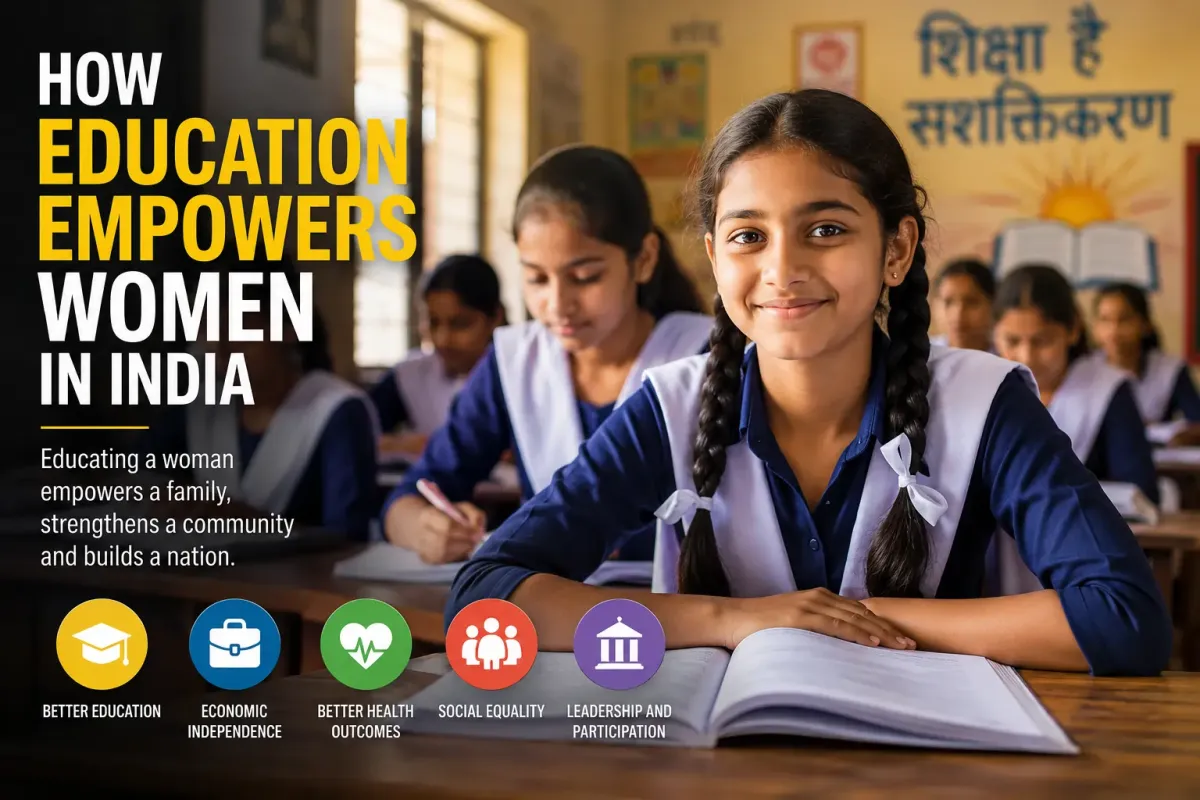
Education is the most direct route to women empowerment in India. Female literacy in the country was only nine percent when the nation was born and continues to be unequal across states, caste, income, and the rural-urban divide.
Women’s empowerment is a process that goes beyond getting enrolled in schools as it unlocks a woman’s ability to make choices about her own life, body, and role in society. Every additional year of schooling increases women’s earning capacity, reduces marriageability, improves health-seeking behaviour and fertility control, and enhances their ability to participate in and benefit from public life.
However, patriarchal norms, poverty, and safety issues make it challenging for girls, particularly at the secondary level, to stay in school. The government has taken several steps, some of which are the Right to Education Act, 2009; Mahila Samakhya, and Beti Bachao Beti Padhao to overcome these challenges. The policies and programs need to be coordinated with other relevant sectors to improve female literacy, with a focus on achieving lasting empowerment outcomes for women across the country.
Historical Perspective
The history of female education in India reflects the changing socio-cultural norms in society. While India’s ancient literature documents the presence of highly educated women, medieval India saw a decline in female literacy. The 19th century witnessed the opening of missionary schools, and the contribution of social reformers such as Jyotirao and Savitribai Phule. Independent India prioritized female education, although female literacy in the country was only nine percent when the nation was born. Indeed, prior to 1947, there was an inverse relationship between gender and literacy in India as it was widely held that boys should be educated, but not girls.
The female literacy rate grew three times faster between 1901 and 1981, compared to the male counterpart. It took more than half a century for female literacy to rise from roughly nine percent to over twenty-six percent (1981). Since 1947, female literacy in India has been on a steady rise, with the pace picking up strongly after the economic reforms of 1991.
Despite the overall increase, female literacy continues to lag behind that of males, and varies greatly across states, caste, and income. For instance, girls from scheduled caste, tribe, and the poor, and those in rural areas are more likely to have less education. Similarly, women are significantly under-represented in science and technology and postgraduate studies.
Initiatives and Policies
India has had a gender-equal education policy since the 1960s, which was articulated in the National Policy of Education (NPE) of 1968, and the subsequent NPE of 1986/92. The NPE set ambitious targets for achieving universal education, with a focus on equality and quality. Other notable initiatives include the Sarva Shiksha Abhiyan, launched in 2001 with the objective of universalizing primary education, and the Right to Education Act, 2009.
The latter makes primary education free and compulsory and prohibits discrimination in education. Other relevant initiatives to improve female literacy include the Kasturba Gandhi Balika Vidyalaya hostel-school complex and the Beti Bachao Beti Padhao campaign launched in 2015. Several states have rolled out similar innovative programs such as free bicycles and mid-day meals to reduce female drop-out rates.
Notably, the Mahila Samakhya, MS, program is the most successful initiative that has directly contributed to women empowerment in India. MS was launched in 1989 with the objective of addressing gender inequality in education by working with grassroots women’s groups. It sought to challenge the status quo that denied women education and voice in society. In other words, MS aimed to create a conducive environment for girls to pursue their studies by empowering women through awareness and organizing them into women’s groups.
Benefits of Education
Household income, child health, and gender equality are some of the most important benefits of female education. Economically, each additional year of learning increases a woman’s earning capacity and makes her desirable in the labor market. For instance, female-headed households are more likely to start and sustain small businesses due to their improved financial literacy and management skills. Female education also helps in diversifying the sources of income and smoothing household consumption as women are able to save and access credit.
Some of the key policies that could improve female education and by extension, economic empowerment include expanding scholarship programs at the secondary and post-secondary levels, providing vocational training that responds to local labor market needs, and promoting safe transportation to and from school.
In terms of health, female education has a positive impact on fertility control, prenatal and postnatal care, and reduced infant and maternal mortality. Schooling increases a woman’s knowledge of healthy practices, such as balanced nutrition and immunization, which subsequently reduces mortality and morbidity. Moreover, being educated enables women to space their childbirth, therefore reducing health complications associated with short birth intervals. Education also contributes to lower rates of gender inequality by raising women’s voices in decision-making, enabling them to demand their rights, and expanding their social networks. For instance, female education reduces the likelihood of gender-based violence and promotes female participation in local governance. To realize these benefits, policies such as incorporating gender studies in the school curriculum, providing safe learning environments, and enforcing existing laws against gender-based violence are paramount.
Education and Female Empowerment in the Social Sphere
Female education is a critical predictor of women’s empowerment in the social sphere. Patriarchal norms in Indian society have long promoted the notion that girls are not “worth” being educated, especially when compared to boys. Girls’ education is impeded by numerous sociocultural barriers, including parents’ discouragement, the lack of safety during travel, and the stigma around girls receiving higher education. Gender inequality has been intrinsic to social institutions, resulting in an uneven distribution of educational opportunities and, consequently, social empowerment.
Institutional mechanisms that offer safe platforms for marginalized females to acquire knowledge, such as the Mahila Samakhya, are critical to breaking the cycle of suppressed educational access and attainment for girls. To address these barriers, policymakers must prioritize community-based institutional mechanisms that promote girls’ education.
In terms of economic barriers, the high cost of education is a significant barrier to girls’ participation in the education system, especially for those from low-income households. Children from economically disadvantaged families are more likely to be deprived of education as parents are more likely to keep their daughters at home to help with domestic chores and earn income.
Such challenges could be resolved by implementing financial inclusion programs such as scholarships or cash transfers to vulnerable households. Additionally, establishing safe and accessible transportation routes to and from school would allow more girls to access education.
Girls’ education in rural and distant localities is hindered by the absence of schools, long distances, and the lack of female teachers. These barriers are more severe in remote areas, especially in hilly and mountainous regions with poor road access. Additionally, female literacy in India is lower in rural areas than in urban areas. As a result, female literacy rates in the former are significantly lower than in the latter. States with high poverty levels, low literacy levels, and traditional attitudes that undermine female education are likely to struggle with implementing effective female literacy initiatives.
The enrollment of girls in primary schools is now almost universal in most states thanks to free primary education, mid-day meal programs, and other recent initiatives such as the Samagra Shiksha and National Education Policy 2020. Enrollment rates at the secondary level are rising, albeit slowly, and female literacy rates in the country appear to be following a similar pattern.
Challenges in Girls’ Education
According to the Mahila Samakhya study, the experimental intervention had a meaningful effect on girls’ schooling. On average, girls in the treatment group had completed 1.18 additional years of formal instruction than boys. Girls in the treatment group were more likely to finish primary and secondary education and less likely to marry as compared to those in the control group. The impact was highest among the youngest girls and those who had been exposed to Mahila Samakhya for the longest time. The findings are typical of those observed in other states, with the exception of those in the lowest income brackets and those in the farthest reaches of the states.
Across states, caste, and income, the enrollment of girls differs significantly. Girls from high-income families are more likely to be enrolled in school than those from their counterparts. Within states, disparities also exist, with urban girls being more likely to be educated than their rural counterparts. Northern states also report having fewer female students than their southern counterparts. Girls are less likely to be enrolled in schools due to cultural beliefs that prioritize their marriage at a young age and their role as wives and mothers.
Consequently, many girls leave school to care for their siblings or to help with domestic chores. Dropout rates peak between the upper primary and secondary levels and can be addressed by providing evening classes, as well as developing bridge programs that provide students with the necessary competencies to transition from one level to the next.
Female Representation in Higher Education
There has been a tremendous increase in female enrolment in colleges and universities over the years. Currently, women outnumber men in undergraduate programs and are enrolling in postgraduate studies in greater numbers. Female literacy has had a significant impact on women’s higher education enrolment.
Girls from rural, tribal, and low-income households are unable to pursue higher education due to exorbitant fees and the distance of hostels from their homes. Scholarships and subsidies have helped low-income households and marginalized groups such as the scheduled caste and tribe to enroll in institutions of higher learning. Other initiatives such as flexible hours, and safe and secure hostel environments have helped married women to balance their studies and family needs.
Courses such as vocational and technical training are increasingly being used by women to gain skills and enter careers in healthcare and social work, catering, information technology, and textiles. Gender segregation continues to characterize professional courses such as medical and law, with female students outnumbering their male counterparts in some areas of study. Female students perform better than their male counterparts in entrance examinations, therefore being admitted to professional schools in greater numbers. Various institutions organize mentorship programs that facilitate the smooth transition from school to college and thereafter to the corporate world.
Impact at the Household and Community Levels
Female literacy has a positive effect on local governance as women who are literate are more likely to participate in decision-making forums such as the panchayat system and vote. Consequently, these women are more likely to hold office and improve public goods and services such as access to potable water and functional schools in their communities.
Female literacy empowers women to ensure that their voices are heard and that their leaders perform better by auditing public expenditures. Female education also has an impact on immunization, school enrolment, and reduced child marriage rates. Literate women are more likely to increase girls’ enrolment in schools and delay their marriage, thereby improving their overall well-being.
Looking at the Future
The following are recommendations for improving female literacy and, by extension, female empowerment: invest in early childhood education and keep girls in school, particularly at the secondary level; provide conditional cash transfers to families who send their daughters to school; ensure school safety and promote alternative education programs such as evening and bridge classes; promote community-based sensitization to reduce gender stereotypes and address child marriage and poverty; invest in female-friendly and flexible education programs to increase female labor force participation; collect gender-disaggregated data to guide policymaking and measure progress; and enforce affirmative action to ensure that female literacy results in professional and leadership representation.
Community-based empowerment programs such as Mahila Samakhya should be scaled up and leveraged to achieve better female education outcomes. Female education initiatives require a multi-sectoral approach that cuts across education, health, and social welfare.