
Opinion
Behind Closed Doors: Why Millions of Women in Rural India Still Choose Cloth Over Pads
By Dona Kundu · Published: Aug 01, 2026 10:11 PM
6 min read
Why Cloth Remains a Menstrual Hygiene Choice in Rural India
In a small village on the outskirts of Muzaffarpur, Bihar, sixteen-year-old Rina waits until dusk to wash a strip of old cotton cloth behind her house. She rinses it quickly, wrings it out, and tucks it under a pile of clothes to dry rather than leaving it on a line where a neighbour might see.
This ritual, repeated every month, is not necessarily born of ignorance. It is often shaped by circumstance.
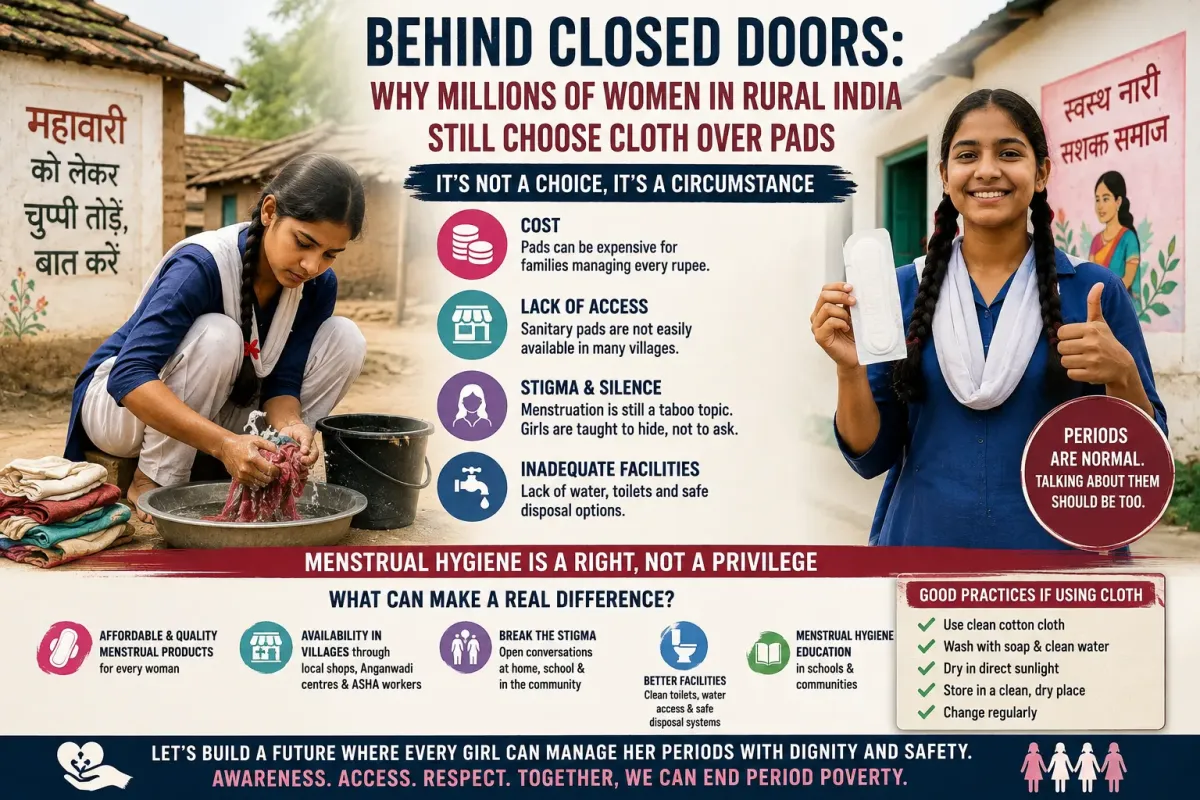
Across Bihar, Uttar Pradesh and other rural parts of India, millions of women and girls continue to rely on cloth instead of sanitary pads. The reasons extend beyond awareness and include affordability, availability, access to local markets, sanitation facilities and the social stigma surrounding menstruation.
It's Not Just About Awareness
For years, public health campaigns have often approached menstrual hygiene as an awareness issue. But realities in rural communities suggest that awareness alone cannot address the barriers women face.
Studies of menstrual hygiene management in rural and peri-urban India suggest that the use of cloth can be a practical choice shaped by economics and geography. Affordability, limited availability of sanitary products in local markets and poor access to shops selling them can push women towards a material that is already available at home.
Stigma adds another layer. In many households, menstruation is still discussed only in whispers, if at all. Girls may learn to hide their periods rather than ask questions or request money for sanitary products from family members who consider the subject taboo.
“The use of cloth instead of sanitary pads is not always due to a lack of awareness. For many women in rural Bihar and Uttar Pradesh, affordability, limited availability of sanitary products, and poor access to markets are major barriers. In some communities, cultural taboos and social stigma around menstruation also discourage women from discussing or adopting menstrual hygiene products.”
— Dr. Rosalin Patasini Mishra, President - Parichay Foundation, Founder-Parineeti, Social Entrepreneur and Social Change Agent
The Weight of Period Poverty
The challenges faced by women in these communities are part of what is commonly described as period poverty. It refers to inadequate access to menstrual products, hygiene facilities, waste disposal and information because of financial and geographical barriers.
In India, period poverty is not necessarily confined to the poorest households. It can also affect lower-middle-income families where household budgets leave little room for additional expenses.
The consequences can extend beyond menstrual hygiene. Girls without reliable access to menstrual products or clean and private toilets may miss school during their periods. Repeated absences can affect education and, in some cases, contribute to girls dropping out.
Some women and girls also face restrictions on cooking, entering kitchens or attending religious functions while menstruating. These social restrictions add another layer to the material challenges, affecting education, mobility and dignity.
The Economics of Menstrual Hygiene
For a rural household managing a limited monthly budget, the cost of sanitary products can become a significant consideration. A month's supply of sanitary pads may compete with other essential household expenses.
Cloth, by comparison, is already available in many homes, can be reused and does not require a separate purchase or a trip to a market that may not stock sanitary products.
Research on menstrual hygiene management across rural and semi-urban parts of India has similarly highlighted how product availability, cost, water access and sanitation infrastructure can interact and influence menstrual hygiene practices.
“Awareness is part of it, but let's be honest: it's also about access and dignity. In many villages, you won't find pads in the local kirana shop. And if you do, a month's supply costs what the family spends on vegetables for 3 days. So women go back to cloth because it's reusable and it's free.”
— Dr. Shanthini Sounder, Obstetrician & Gynaecologist, Gleneagles Hospital
When Cloth Becomes a Health Concern
There is an important distinction when discussing the use of cloth for menstrual hygiene. Cloth itself is not inherently unsafe. Clean cotton cloth that is properly washed with soap and dried thoroughly in direct sunlight can be used safely by many women.
The concern arises when the conditions surrounding its use make proper hygiene difficult. Cloth may be washed hastily, dried in poorly ventilated or hidden spaces, or stored before it is completely dry because women are reluctant to let others see it.
Community health reports have described cases involving symptoms such as chronic white discharge, itching and urinary tract infections among young girls where unhygienic menstrual practices have been identified as a contributing concern.
The material itself is not necessarily the problem. Damp or inadequately cleaned cloth, combined with poor hygiene conditions, can increase the risk of infection.
“While clean, properly washed and sun-dried cloth can be a safe option, the challenge arises when unhygienic practices increase the risk of infections. The solution is not just awareness but ensuring affordable menstrual products, improving access, breaking social stigma, and providing menstrual hygiene education so that women can make informed choices with dignity.”
— Dr. Rosalin Patasini Mishra
“Unclean cloth is a direct invitation to infection. I see young girls with chronic white discharge, itching, and UTIs every month, and the root cause is the same. Cloth is not the enemy. Dirty, damp cloth is. If a woman must use cloth, it has to be clean cotton, washed with soap, and dried in the sun, not hidden under the bed. But the real fix is making good quality low-cost pads available at the Anganwadi and ASHA level and talking about periods without shame.”
— Dr. Shanthini Sounder
What Could Actually Help
Health researchers and grassroots workers point towards solutions that go beyond awareness campaigns. Affordable menstrual products need to reach rural markets, supply chains need to reliably serve villages, and social stigma around menstruation needs to be addressed alongside practical menstrual hygiene education.
One approach is to use healthcare and community systems that already have a presence in rural India. Anganwadi centres and ASHA workers can serve as important touchpoints for making good-quality, low-cost menstrual products accessible while also creating opportunities for conversations about menstrual health.
For women like Rina, change is unlikely to come from a single awareness campaign or a single subsidised packet of pads. It may require a combination of accessible products, supportive family members and teachers, and health workers who can discuss menstrual hygiene without judgement.
Moving Beyond Silence and Stigma
The continued use of cloth for menstrual hygiene cannot be understood simply as a failure of awareness. For many women and girls, it reflects the practical realities of household budgets, product availability, market access, sanitation and social attitudes.
Improving menstrual hygiene therefore requires more than encouraging women to switch from cloth to pads. It requires making safe choices affordable and accessible while ensuring that women have accurate information and the freedom to make informed decisions about their own menstrual health.
Until those conditions improve, the quiet ritual of washing and hiding menstrual cloth may continue in many rural households — not necessarily out of ignorance, but because of the persistent arithmetic of rural life.