
Opinion
Home Deliveries in Rural India Highlight Persistent Gaps in Maternal and Newborn Healthcare
By MILLENNIUM NEWSROOM Desk · Published: Jul 30, 2026 08:36 PM · Updated: Jul 30, 2026 10:58 PM
6 min read
Home Deliveries Continue to Raise Concerns Over Maternal and Newborn Healthcare
In Kamalpur village in Madhubani, Bihar, Aman Kumar's (name changed) wife gave birth to a daughter in June 2026. The newborn survived for only two days. According to family members, the child had her mouth open from the time of birth, leading them to believe that she may not have been able to breathe through her nose. From birth until her death, there was reportedly no medical supervision.
Aman Kumar is an educated professional working for a corporate organisation in an Indian city. Yet, according to the family, no one considered taking the newborn or mother to a government hospital located around 15 km away.
The case reflects a larger concern in parts of rural Bihar and Uttar Pradesh, where some families continue to prefer home deliveries despite the availability of healthcare facilities.
When Home Delivery Becomes a Family Tradition
A similar case was reported in Mau, Uttar Pradesh, in 2019. A woman gave birth at home and began experiencing complications immediately. The child was taken to a hospital only after five days and died on the seventh day. When the doctor asked why the mother had not been brought to the hospital during delivery, the response was, "Humara ghar me aise he hota hai" (The deliveries in our family take place at home).
Reportedly, families in areas including Kamalpur, Pandaul, Bhawanipur, Lakshmipur, Sakri, Rajnagar and Sisho continue to have reservations about institutional deliveries and prefer childbirth at home. Several areas of Uttar Pradesh, including Chandoli, Jaitpur and Nandganj, are also reported to face similar challenges.
“Home births remain common where families feel facility delivery is unnecessary, cannot reach care quickly, or face financial and permission-related barriers. In short, awareness matters, but access, poverty, hygiene, and delayed medical intervention are just as important.”
Home Deliveries Are About More Than Awareness
Experts say home deliveries in rural Bihar and Uttar Pradesh cannot be viewed only through the lens of awareness. Poverty, inadequate transport, distance from healthcare facilities, limited access to antenatal care and long-standing cultural practices can all influence where and how women give birth.
In many communities, women may also have limited influence over decisions concerning their own healthcare. These factors can combine to delay access to skilled medical care when complications arise.
"The deaths of newborns in the first few days are often due to preventable complications like infections, birth asphyxia, or the lack of immediate medical care. The focus should be on improving healthcare access, strengthening maternal services, and building trust within communities so that every mother can have a safe delivery."
— Dr. Rosalin Patasini Mishra, President, Parichay Foundation; Founder, Parineeti
Healthcare Access and Trust Remain Critical
Access to healthcare in rural communities is shaped by a complex combination of social and economic factors. There are also allegations that some people seeking treatment at government hospitals encounter brokers who demand commissions to arrange hospital beds, creating another potential barrier for families seeking care.
At the same time, social attitudes and established family practices can influence healthcare decisions. The continued occurrence of home deliveries in an era of advanced medical technology highlights the gap that can exist between the availability of healthcare and people's willingness or ability to use it.
According to the Ministry of Health and Family Welfare's National Family Health Survey-6, released by the Press Information Bureau on May 29, 2026, institutional deliveries in India increased from 88.6 per cent in 2019-21 to 90.6 per cent in 2023-24. The NFHS-6 covered nearly 6.79 lakh households across 715 districts.
The figure represents substantial progress, but it also means that institutional delivery was not recorded for 9.4 per cent of births in the survey. The national figure, however, does not by itself explain the differences in healthcare access, availability of transport, antenatal care or social practices across individual communities.
Why Immediate Medical Care Matters
The risks associated with childbirth do not end with the mother. Complications affecting a newborn can also become life-threatening within hours or days.
"Reducing maternal and new-born deaths therefore requires more than encouraging families to choose institutional deliveries. It calls for stronger antenatal care, timely access to skilled obstetric services, better emergency transportation and fewer financial, geographical and social barriers to accessing healthcare facilities."
— Dr. Shibal Bhartiya, Founder, Vision Unlimited
During labour, a mother may develop sudden heavy bleeding, prolonged or obstructed labour, high blood pressure, infection or other complications that may require immediate medical treatment or surgery. For a newborn, breathing difficulties, premature birth, low birth weight, birth injuries and infections can become serious within a short period.
The Risk of Delayed Intervention
"The greatest fear is the lack of immediate emergency treatment. In a properly equipped birth facility or hospital with trained healthcare professionals present, both mother and baby can be monitored and hygiene maintained, warning signs identified early and immediate treatment provided where needed."
— Dr. Nidhi Rajotia (Goel), Unit Head - Obs & Gynae, Artemis Hospitals
The concern is not that every home delivery will necessarily result in a complication. The challenge is that complications can arise unexpectedly, leaving families with limited time to arrange transportation and reach a facility capable of providing emergency care.
Beyond the Numbers: Changing Social Attitudes
India's progress in institutional deliveries demonstrates that access to maternal healthcare has improved considerably. However, national averages cannot capture every local reality. A family may live within a certain distance of a hospital and still face financial, transportation, social or cultural barriers that prevent timely use of the facility.
For families accustomed to home deliveries, childbirth may be viewed as a familiar and convenient process. But when unexpected complications arise, the absence of trained healthcare professionals, monitoring equipment, hygiene measures and emergency treatment can increase the risks to both mother and newborn.
The challenge, therefore, extends beyond awareness campaigns. Improving maternal and newborn outcomes requires stronger antenatal care, reliable emergency transportation, accessible health facilities and sustained efforts to build trust between communities and healthcare providers.
Maternal and Newborn Safety Requires Collective Responsibility
Rigid social constructs and limited awareness can contribute to decisions around home deliveries, but the issue cannot be placed entirely on individual families. Healthcare access, community trust, household decision-making, poverty, transport and the quality and availability of medical services all form part of the larger picture.
Preventable newborn deaths are more than a percentage in a national health survey. Each represents a family and a life lost at the beginning of it. Ensuring safer childbirth requires society, healthcare systems and communities to recognise that timely medical care can make the difference when complications occur.
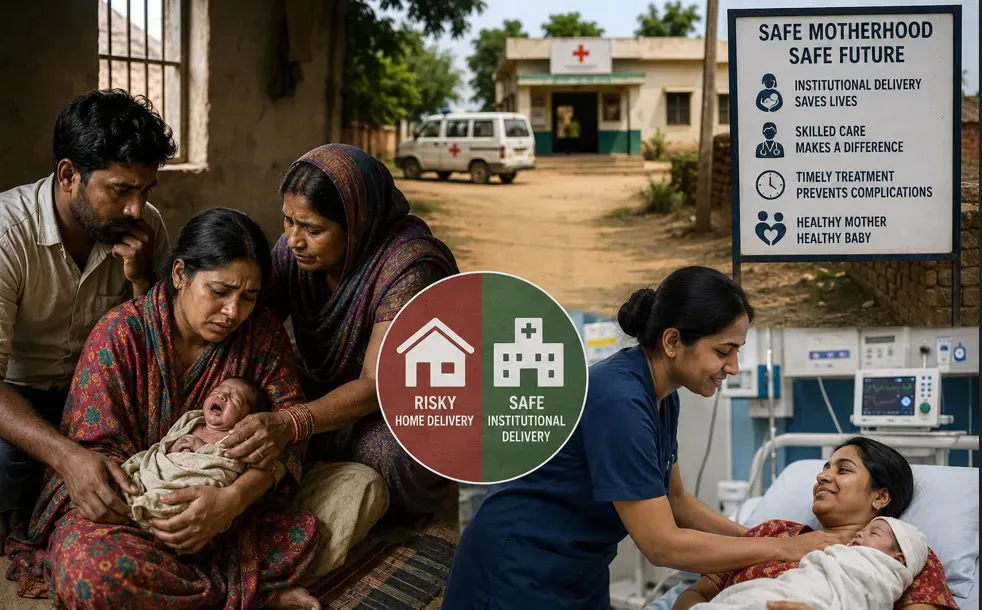
(AI generated image)