
Markets
How AI Is Helping New-Age Investors Make More Informed Stock Market Decisions
By MILLENNIUM NEWSROOM Desk · Published: Aug 26, 2026 07:13 PM
6 min read
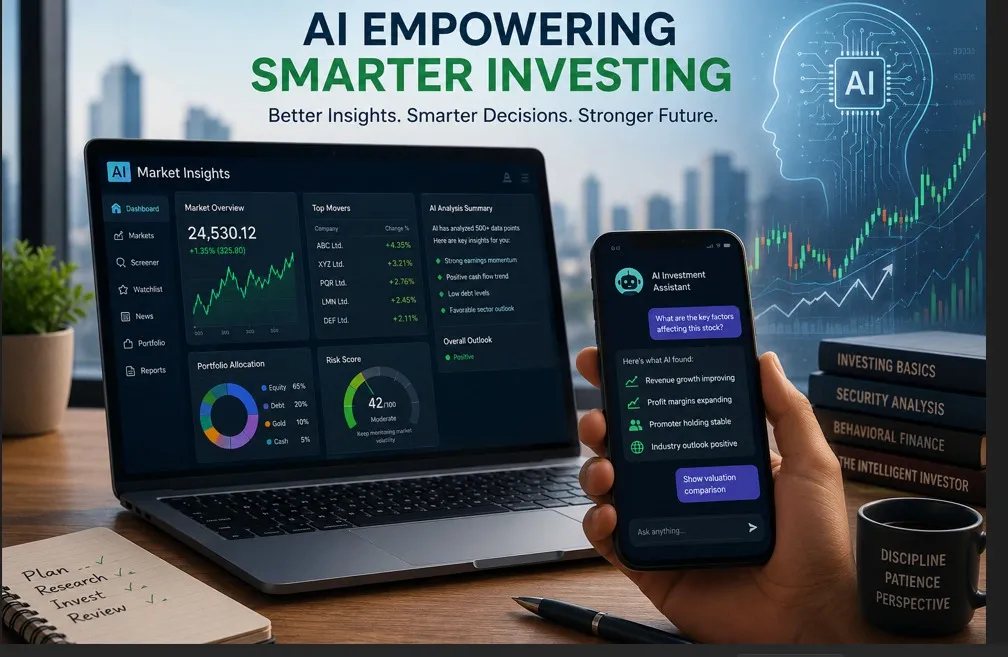
Artificial intelligence is changing the way new-age investors research and approach the stock market. As AI tools become capable of processing financial statements, regulatory filings, market data and news at scale, sophisticated research is becoming increasingly accessible beyond traditional institutional investment desks.
But the democratisation of information does not necessarily eliminate the advantage of institutional investors. Instead, it changes where that advantage lies. Hemant Sood, Founder and Managing Director, Findoc Group, puts it succinctly: “AI is not eliminating the institutional advantage. It is moving where that advantage sits.”
Historically, institutional investors benefited from access to information, large teams capable of processing it and the infrastructure required to act on it. AI is increasingly reducing the importance of the second of these advantages. An individual investor can now analyse several years of annual reports, earnings calls, exchange filings and peer comparisons in minutes.
The shift means that simply having more analysts may become less valuable. The competitive edge is increasingly likely to come from proprietary data, asking better questions, execution capability and risk management.
AI Is Automating the Heavy Lifting of Stock Market Research
A significant part of stock market research involves repetitive processes: screening companies, comparing financial statements, tracking regulatory developments, monitoring news and studying historical data. These are areas where AI can substantially reduce the time required for analysis.
AI can conduct the first reading of annual reports, compare disclosures across years and flag developments involving auditor language, promoter pledges, contingent liabilities, related-party transactions, credit ratings and management commentary. It can also continuously monitor news and regulatory filings instead of relying on an analyst to identify developments manually.
Agentic AI systems can extend this capability further by screening thousands of stocks, tracking insider filings, summarising earnings calls and backtesting strategies against historical data. Processes that previously required significant research manpower can therefore be completed much faster.
Ramakant Yadav, Founder of Scalar Field, a Y Combinator-backed agentic AI research and trading platform, describes the changing role of investors this way: “AI automates answers. Investors still own the questions, and the consequences.”
That distinction is crucial. Automation can make information easier to process, but it does not determine which investment thesis deserves capital or how much of an investor's savings should be allocated to it.
Human Judgement Still Matters in AI-Powered Investing
As routine research becomes automated, human judgement could become more important rather than less.
AI can identify that receivables have risen sharply, for example, but the investor still has to determine why. The increase could reflect rapid growth, deteriorating customer quality or aggressive accounting. Similarly, AI can identify a promoter's capital-allocation history, but deciding whether management can be trusted through a difficult business cycle remains a more complex judgement.
The same applies to market conditions. Investors must recognise when a market regime has changed enough for historical patterns to become less useful. They must also assess price, determine appropriate exposure and remain accountable for the consequences of their decisions.
This creates an important distinction between information processing and investment judgement. AI may make the first stages of research significantly cheaper, but the remaining decisions can become disproportionately valuable because they involve interpretation, accountability and risk.
More AI Trading Could Improve Efficiency — and Amplify Herd Behaviour
The expansion of algorithmic and AI-driven trading could make markets more efficient. Automated systems can identify obvious mispricing quickly, potentially narrow spreads and incorporate new information into prices almost instantly.
However, automation also introduces a different type of risk: correlation.
If thousands of AI systems consume similar data and use similar strategies, they could reach similar conclusions at almost the same time. Human investors may exhibit herd behaviour over hours or days, but algorithmic herd behaviour can emerge within milliseconds.
This could turn a relatively small market shock into a rapid price movement before human participants have time to respond.
The concentration of activity in short-dated derivatives makes this particularly significant. In such an environment, the challenge is not simply developing better trading signals. Risk architecture becomes equally important, with measures such as anomaly detection, position limits, throttles and kill switches helping manage extreme outcomes.
The goal is therefore not necessarily to reduce automation, but to ensure that increasingly automated markets retain sufficient diversity of strategies and effective risk controls.
AI Can Increase Confidence Faster Than Competence
For new-age investors, one of the biggest risks is treating AI-generated analysis as a substitute for understanding risk, valuation and market cycles.
A convincing AI response can appear authoritative even when an assumption, valuation input or factual number is incorrect. This can be particularly dangerous in investing because confidence in an analysis can encourage an investor to take a larger position.
Another concern is confirmation bias. An investor who has already decided to buy a stock could repeatedly adjust prompts until an AI system produces a bullish thesis. Instead of challenging the investor's assumption, the technology could end up validating it.
There is also a risk of “borrowed conviction” — relying on confidence generated by an AI model without developing an independent investment thesis. Backtested strategies can present another problem because historical performance does not guarantee that a strategy will continue working, particularly if large numbers of investors begin following it.
The emergence of scams adds another layer of risk. AI-themed investment tips can be used to repackage older schemes through Telegram groups and finfluencers. A genuine research tool should therefore encourage testing and understanding rather than simply provide a trading tip.
Turning AI Into a Tool for Disciplined Investing
AI's biggest opportunity may not be telling investors what to buy. It could be helping them understand their own behaviour.
An AI-powered system could show an investor how frequently they trade derivatives, their net profit or loss after costs, which trades have contributed most to losses and how much of their investible portfolio a proposed position represents.
Such personalised feedback could be more effective than generic risk warnings because it connects financial discipline to the investor's own behaviour.
AI can also make concepts such as valuation, diversification, drawdowns and compounding easier to understand by using an investor's portfolio and communicating in languages such as Hindi, Punjabi, Tamil or Bengali.
Another route is to make disciplined research as accessible as speculative tips. Testing an investment idea against previous market cycles can help investors understand how their strategy might behave under different conditions. Automated rules for position sizing, rebalancing and exits can also reduce the influence of emotions when markets move sharply.
AI agents can further challenge investors by asking questions about their investment horizon, income and tolerance for losses before acting. This creates a model in which technology does not simply agree with an investor but encourages them to examine their assumptions.
Ultimately, AI is unlikely to make informed investing a purely automated process. Its greatest value may lie in making high-quality research faster, more accessible and more personalised while leaving the responsibility for judgement and risk with the investor.
As AI continues to reshape stock market research, the new information advantage may therefore belong not to those who simply have access to the technology, but to those who know how to question it, test its conclusions and use it without surrendering accountability.