
Lifestyle
Divorce Cases Rising in Urban India as Young Couples Rethink Marriage and Explore Live-In Relationships
By MILLENNIUM NEWSROOM Desk · Published: Aug 05, 2026 07:05 PM
5 min read
Marriage in Urban India Is Being Reconsidered
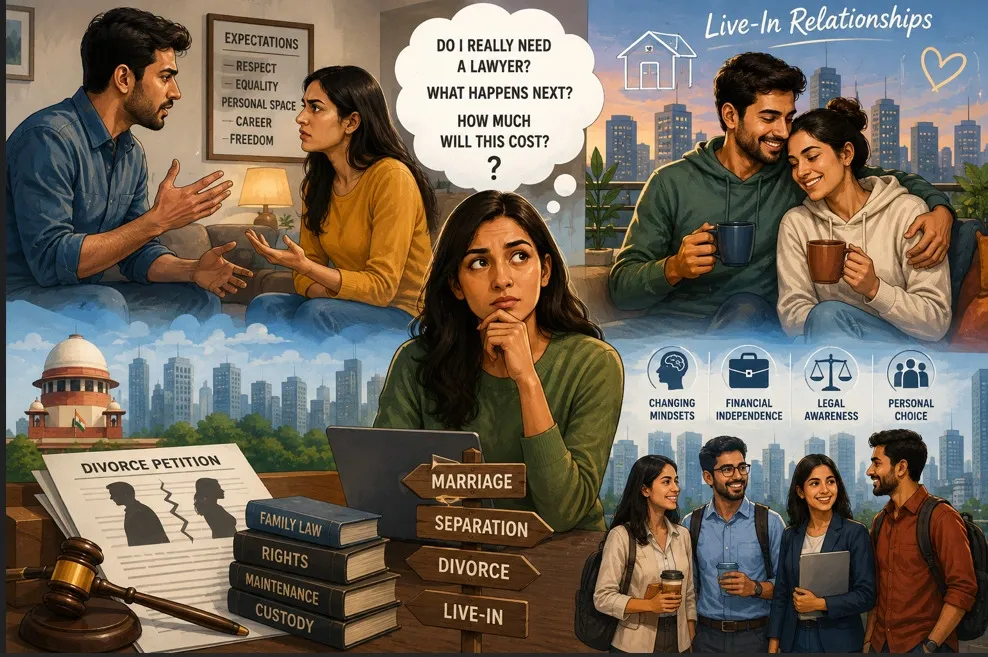
For a generation that grew up viewing marriage as a lifelong commitment, the idea of walking away from one is no longer as unthinkable as it once was. In India's cities, where young couples are increasingly financially independent and exposed to different ideas about relationships, marriage is being viewed less as an unquestionable social obligation and more as a personal choice.
That shift is also becoming visible in matrimonial disputes. Delhi High Court advocate S.S. Parasher, who has dealt with matrimonial matters, points to changing expectations between spouses, financial independence and growing individualism as some of the factors behind increasing marital conflicts in urban India.
“In most of the cases husband and wife are earning handsomely. Both have their own priorities. Wife equally claims to have all rights as that of an individual need to develop himself. On the other hand husband takes it an encroachment over his male dominance, he witnesses from his childhood in his family,”
— S.S. Parasher, Delhi High Court Advocate
The observation reflects a broader transformation in Indian households. As more couples build dual-income families, expectations around equality, personal space and decision-making within marriage are also changing. At the same time, greater awareness of legal remedies means that couples who may previously have remained in unhappy marriages now have more avenues to seek separation.
Parasher identifies two factors particularly clearly:
“Easy access to legal remedies and intolerance against each other.”
Divorce Filings Are Rising in Some Urban Centres
The trend, however, needs to be understood carefully. A rise in divorce filings does not necessarily mean that marriage itself is disappearing. India continues to have a predominantly marriage-oriented society, but the age at which people marry, how they meet partners and what they expect from relationships are changing, particularly in urban centres.
Hyderabad, for instance, recorded a 25% increase in divorce filings over five years, with cases across its three family courts rising from 4,805 in 2019 to 6,406 in 2024, according to a media report. Legal experts cited changing expectations, women's financial independence, job stress and compatibility issues among the factors contributing to marital disputes.
The pattern points towards a broader change in how couples approach marriage. Financial independence can give individuals greater ability to make decisions about relationships, while changing expectations around companionship, equality and personal freedom can also alter how marital disagreements are perceived.
Live-In Relationships Gain Visibility
At the same time, an alternative relationship model is gaining visibility: the live-in relationship.
A 2024 field survey examining changing attitudes towards live-in relationships found that among 432 respondents, 37% either agreed or strongly agreed that people choose live-in relationships because there is no formal divorce procedure, although 32% remained neutral.
The study also found that 37% agreed or strongly agreed that divorce cases had increased alongside the emergence of live-in relationships, while 40% were neutral.
These findings indicate a perception of a relationship between the two trends, but they do not establish that live-in relationships cause divorce.
What Does the Law Say About Live-In Relationships?
Legal developments have also made live-in relationships more visible within India's judicial framework. The Supreme Court of India has repeatedly considered the legal implications of relationships between consenting adults outside formal marriage.
In a 2025 judgment, the Court observed that when two adults live together as a couple for an extended period, the length of the relationship and conduct of the parties can be relevant when determining whether their relationship was based on consent.
The judgment also discussed the impact of financial independence and the increasing prevalence of live-in relationships. The Court emphasised that such matters should be examined in their specific factual and legal context rather than through a purely rigid approach.
Live-In Relationships Are Not Replacing Marriage
Importantly, live-in relationships are not simply replacing marriage across India. Research on Indian youth has found that while attitudes towards cohabitation are becoming more accepting, it would be inaccurate to conclude that live-in relationships have overtaken marriage as the preferred institution.
What appears to be changing is the meaning attached to commitment itself. For some young Indians, compatibility, independence and personal choice are becoming prerequisites for marriage rather than consequences of it.
For others, living together without marriage offers a way to build a relationship without immediately entering a formal legal and social institution.
A Generation Rethinking the Meaning of Commitment
Parasher sees this transformation as significant.
“A trend is developed of having live in relationship. I have realized that coming generation is not relying on marriage bonding,”
— S.S. Parasher, Delhi High Court Advocate
The observation points towards a wider change in urban relationship dynamics. Young couples are increasingly evaluating relationships through factors such as compatibility, equality, independence and personal choice, rather than viewing marriage as an institution that must be preserved regardless of circumstances.
Divorce and Live-In Relationships Reflect a Larger Social Shift
The bigger story, therefore, may not simply be that divorce cases are rising or that young people prefer live-in relationships. It is that urban India is witnessing a deeper renegotiation of marriage itself.
Marriage continues to hold significant social and cultural importance in India. However, for an increasingly independent urban generation, entering and remaining in a marriage is becoming more closely tied to personal compatibility, mutual expectations and individual choice.
As legal awareness expands and alternative relationship structures become more visible, the institution of marriage may continue to evolve. The change is not necessarily about replacing marriage with live-in relationships. Instead, it reflects a generation increasingly asking what commitment should look like — and whether it should be defined by tradition alone or by the choices of the people involved.