
Lifestyle
Breaking the Cycle: How Children Who Witness Domestic Violence Are Affected
By MILLENNIUM NEWSROOM Desk · Published: Aug 07, 2026 06:58 PM
7 min read
When Childhood Becomes Entangled With Domestic Violence
For Ananya (name changed), the memory of childhood is inseparable from what happened inside her home.
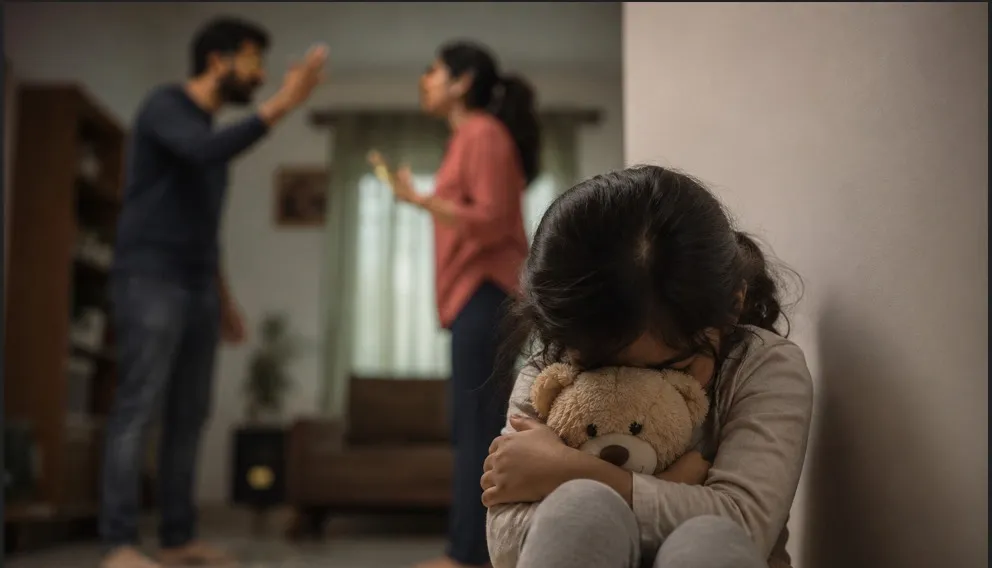
She grew up watching domestic violence between her parents. One parent was the victim and the other the aggressor. As a child, she found herself caught between fear of the parent who could hurt and concern for the parent who seemed unable to protect themselves. There was little room left simply to be a child. She became conscious of what she could ask for, what she could say and what might happen next.
Over time, she learned to suppress her needs. If the parent being hurt could not protect themselves, could they protect their child? And if approaching the other parent felt frightening, where could a child turn?
“A child who is a product of a domestic violence marriage is often lost.”
— Gauri Joshi, Social Activist and Founder, The Soul School
That sense of being lost captures a less visible dimension of the effect of domestic violence on children. The child does not have to be physically attacked to be affected by violence. Witnessing one parent being threatened, humiliated or assaulted can change the child's understanding of safety, trust, conflict and even love.
Research increasingly supports this concern. The World Health Organization recognises witnessing violence between parents or caregivers as a risk factor for violence against children and says exposure to violence can have lifelong effects on health and wellbeing. These can include mental-health problems, difficulties with cognitive and educational development, behavioural problems and a greater risk of later victimisation or perpetration of violence.
When Home Becomes a Place of Fear
For a child, the impact can begin with something as basic as hypervigilance.
Children who repeatedly witness conflict may become alert to changes in voice, footsteps, facial expressions or the atmosphere inside the house. They may learn to anticipate an argument before it happens. Some withdraw and become unusually quiet; others express their distress through anger, irritability or behavioural problems.
These are among the patterns described by the second expert in the responses, who has worked with people affected by such experiences. She points to difficulties with trust, self-esteem, emotional regulation and forming healthy relationships as some of the consequences that can emerge.
“Children may not understand every argument they witness, but they always understand how it made them feel.”
— Dr. Munia Bhattacharya, Sr. Consultant, Psychology, Marengo Asia Hospitals, Gurugram
The point is important because children do not always have the vocabulary to explain trauma. A child may not say that they are frightened by violence at home. Instead, the distress may appear as poor concentration, withdrawal, aggression, sleep difficulties or changes in behaviour.
WHO notes that violence in childhood can affect brain and nervous-system development and is associated with mental-health problems, poor school performance and other long-term consequences.
The effects, however, are not identical for every child. Exposure increases risk; it does not determine destiny.
What Children Learn About Relationships
The next layer of the problem begins when children start making sense of what they see.
Children learn about relationships not only from what adults tell them but from what adults repeatedly do. If shouting, humiliation, intimidation or physical aggression become familiar features of family life, a child can begin to interpret these behaviours as ordinary ways of resolving conflict.
Repeated exposure can send particularly damaging messages about gender and power. A boy may come to associate anger or aggression with strength. A girl may learn that disrespect is something that has to be endured. The underlying lesson is that love and violence can coexist.
The expert responses highlight this concern, noting that children observe much more than adults may realise and can internalise repeated patterns of behaviour.
This is where the intergenerational cycle of violence becomes a concern.
Research has linked exposure to violence in childhood with an increased risk of later victimisation and perpetration. WHO also identifies a history of exposure to violence and witnessing violence between parents or caregivers among risk factors associated with violence against children.
But this does not mean every child exposed to domestic violence will become abusive or enter an abusive relationship.
The original responses themselves recognise that children can respond in very different ways. Some may seek protection from others, some may attempt to become the stronger person in relationships, while others may reproduce behaviours they saw growing up. Personality, social environment, relationships outside the home and other psychological factors can influence the outcome.
The cycle, therefore, is a risk—not a predetermined future.
The Possibility of Breaking the Pattern
What happens after the exposure can make an important difference.
A child who has grown up around violence may encounter another adult who demonstrates that disagreements can happen without fear, that anger can be expressed without aggression and that love does not require control.
The expert responses emphasise the protective role of a supportive parent, caring relative, understanding teacher or timely psychological intervention. Therapy can help people recognise that the relationship patterns they witnessed were unhealthy and learn healthier ways of expressing emotions, resolving disagreements and building trust.
This is also consistent with broader prevention evidence. WHO recommends approaches that combine support for parents and caregivers, safe environments, education, economic strengthening and appropriate response services for children exposed to violence.
In other words, breaking the cycle requires more than telling a child that violence is wrong. The child needs to experience an alternative.
Why Schools Can Become a Crucial Safety Net
For children living with domestic violence, school may be one of the few places where an adult outside the family can notice that something has changed.
A child who becomes withdrawn, distracted or aggressive can easily be labelled disobedient or careless. But behavioural changes may also signal emotional distress.
The expert responses point to the need for regular teacher training, qualified counsellors and clear referral systems so schools can recognise possible trauma and connect children with appropriate support.
WHO similarly notes that frontline professionals are often inadequately trained to identify and respond to children exposed to violence and emphasises the importance of recognising signs, assessing safety and providing psychosocial support.
That makes the attentive teacher particularly important. Sometimes, the first step towards breaking a cycle is simply an adult noticing that a child's behaviour has changed and asking why.
When Leaving the Household Is Not Simple
There is another reality that cannot be separated from the child's experience: many survivors cannot simply walk away from an abusive relationship.
Economic dependence, social stigma, fear of family breakdown and lack of support can make leaving difficult. In the personal account that forms the beginning of this story, the woman's mother remained in an abusive marriage for years partly because of financial dependence and the absence of sufficient independence. Eventually, support from relatives helped her relocate, after which the abuse ended.
For children, this demonstrates why protecting them cannot be separated from protecting the adult survivor.
The responses emphasise the need for financial support, legal guidance, safe accommodation and psychological counselling for women, alongside emotional support and stability for children. Communities, healthcare professionals, schools and social organisations need to work together rather than operate in isolation.
India has legal mechanisms including the Protection of Women from Domestic Violence Act, 2005, while child-protection frameworks such as the Juvenile Justice Act and POCSO provide additional safeguards in situations covered by those laws. But legal protection is only one part of recovery.
For a child, the end of violence does not necessarily mean the end of its consequences.
Healing Before the Pattern Reaches Another Generation
The most important question, ultimately, is not only how to stop violence but how to prevent what a child has witnessed from becoming part of their own understanding of adulthood.
Early mental-health support and parenting education can help address that problem before fear, silence and unhealthy relationship patterns become deeply embedded. Parents need support to create emotionally safe homes, while children need access to psychological care without stigma.
WHO's current evidence similarly points towards a combination of prevention, parenting support, safe environments, education, economic strengthening and response services rather than a single intervention.
The effect of domestic violence on children can remain invisible for years. It may appear later in the relationships they choose, the conflicts they avoid, the emotions they suppress or the treatment they believe they deserve.
But witnessing violence does not have to determine who a child becomes.
A child who once learned that love could coexist with fear can learn something different. A child who grew up believing that conflict means danger can learn that disagreement does not have to mean violence. A child who once felt lost can find an adult who makes safety feel possible.
Breaking the cycle begins there—not merely when the violence stops, but when a child finally learns that there is another way to live.