Healthcare
AI in Healthcare: The Shift From Reactive Treatment to Predictive, Patient-Centric Care
By MILLENNIUM NEWSROOM Desk · Published: Jul 28, 2026 07:52 PM · Updated: Sep 03, 2026 11:25 PM
5 min read
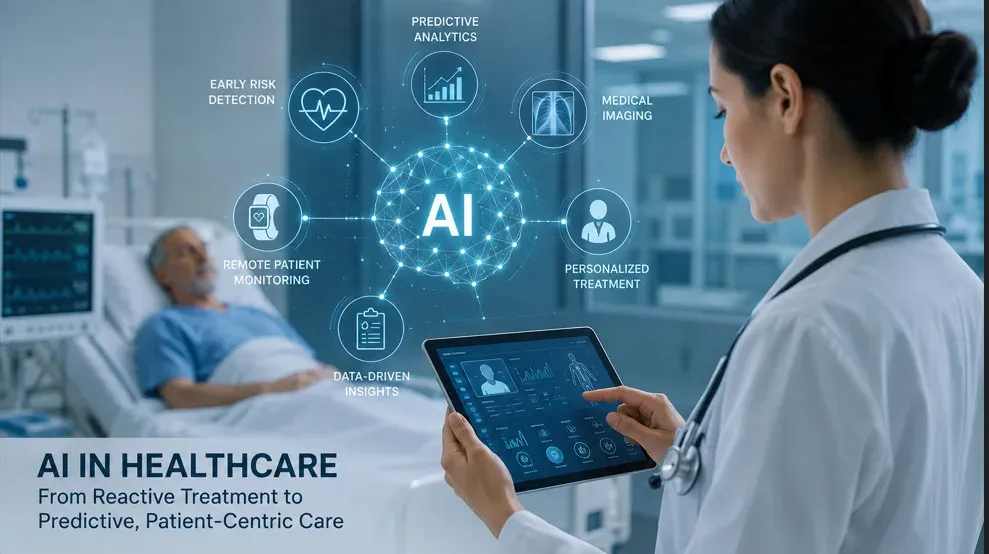
For most of modern medical history, healthcare has run on a simple, unspoken rule: wait for the symptom, then treat it. A patient felt unwell, went to a doctor, and only then did the system spring into action. That model is now being quietly dismantled — not by a single breakthrough, but by the steady convergence of artificial intelligence, connected devices, and the enormous stores of patient data hospitals have collected for decades but rarely used to their full potential. The result is a growing, evidence-backed case for AI in Healthcare as something closer to standard practice than a futuristic add-on.
The Technology Behind AI in Healthcare's Shift From Reactive to Predictive
The clearest evidence of this change is sitting in hospital wards that most patients never see. In 2024, the US Food and Drug Administration cleared an AI-based early warning system for sepsis — one of the leading causes of in-hospital death — developed by Johns Hopkins researchers and commercialized as a clinical product. The system was built to catch pre-suspicion signals hours before a clinician would typically flag a patient as at risk, and in real-world deployments at health systems including Cleveland Clinic and the University of Rochester, it was linked to a substantial drop in sepsis-related mortality.
A wider body of research backs this up: systematic reviews covering studies from 2015 to 2025 have consistently found that machine-learning-based warning systems outperform traditional scoring tools like qSOFA and SIRS, which were never designed to catch the subtle, early physiological drift that precedes a crisis.
"AI is not replacing doctors, it's aiding doctors in making better decisions and insights. Together, these technologies are transforming healthcare to be more integrated, efficient and proactive – ultimately creating a better experience for patients and better outcomes."
AI Is Transforming Medical Imaging
Imaging tells a similar story, and it's arguably where AI in Healthcare has scaled fastest. Radiology has become the single largest category of FDA-cleared AI in medicine — by early 2026, well over a thousand imaging algorithms had been cleared, accounting for roughly three-quarters of all AI medical device approvals in the US.
Tools like Aidoc flag suspected brain hemorrhages and pulmonary embolisms for urgent radiologist review, while platforms such as Viz.ai triage stroke scans and MIT's Mirai model estimates a patient's future breast cancer risk rather than just reading the image in front of it. None of these are meant to replace the radiologist's judgment — they are built to sit alongside it, surfacing the case that needs attention first.
Remote Monitoring Is Making Preventive Care a Reality
Outside the hospital, the same logic is playing out through wearables and remote monitoring. Devices tracking ECG data, oxygen saturation, and blood pressure feed continuous streams into AI models that watch for the kind of slow deterioration a monthly check-up would miss entirely.
A 2025 evidence review by the US Agency for Healthcare Research and Quality found that remote monitoring programs, when paired with structured nurse escalation protocols, cut hospital readmissions by 28 to 40 percent across chronic disease cohorts — a meaningful number for health systems where thirty-day readmissions are both a clinical failure and a financial penalty. Heart failure programs have shown particular promise, with AI models analyzing home telemetry data to predict decompensation events before patients ever feel breathless enough to call a doctor.
What This Looks Like in Practice
"AI has also been making a mark in clinical decision making by analyzing large datasets of medical information to provide evidence-based insights, particularly in complex cases. It also helps the clinician evaluate the success of the treatment and adjust the treatment as needed for the individual patient."
That reframing — from technology-as-replacement to technology-as-timing — shows up again in how frontline clinicians describe their daily work.
"As doctors, our biggest challenge today isn't lack of knowledge. It's managing too much information and still making timely decisions for patients... Now, AI helps us pick up early warning signs. It can flag a patient who might worsen in the ER, detect subtle findings on a scan, and help us personalize treatment for each patient."
The Administrative Layer Nobody Talks About
It's easy to focus on dramatic use cases like sepsis detection and stroke triage, but a large share of AI's real-world impact in hospitals is far less glamorous: scheduling, documentation, and patient-flow management.
"Before AI, healthcare delivery was mostly manual and depended heavily on doctors, nurses, and staff handling records, triage, diagnosis, and follow-up themselves. This often meant slower decisions, more paperwork, longer waiting times, and greater room for human error."
Reducing that friction frees up clinical time that translates directly into more attentive care at the bedside.
Also Read: Zydus, ICMR Receive Approval to Begin Phase III Trial of Desidustat for Sickle Cell Disease
Prevention Is the Real Endpoint
The technologies covered here — sepsis algorithms, imaging AI, remote cardiac monitoring — share a common thread: they all move the moment of intervention earlier. That is the essence of preventive, predictive medicine. Disease risk forecasting models, still an active area of academic research rather than a finished product, aim to push this even further upstream, identifying risk before any measurable physiological change occurs at all.
None of this removes the need for clinical judgment, human empathy, or the trust patients place in their doctors. What it does is compress the gap between a problem forming and a problem being noticed — and in medicine, that gap is often the difference between a manageable condition and a medical emergency.
That, in essence, is the real promise of AI in Healthcare: not a replacement for the doctor, but a system that gets to the patient sooner.