
World news
Trump Alleges China Compromised 2020 US Election Data; Beijing Rejects Interference Claims
By MILLENNIUM NEWSROOM Desk · Published: Jul 17, 2026 04:58 PM
3 min read
US President Donald Trump has accused China of carrying out what he described as the largest compromise of American election data in history, alleging that Beijing obtained 220 million US voter files during the 2020 election cycle. Speaking in a televised prime-time address from the White House, Trump announced that his administration would declassify intelligence detailing what he called "shocking vulnerabilities" in the country's election infrastructure.
The remarks revive Trump's long-standing claims that the 2020 presidential election, which he lost to Joe Biden, was compromised. Trump argued that America's current election system remains vulnerable to interference and warned that future elections could be "rigged and stolen" unless sweeping reforms are implemented.
Trump Alleges Massive Election Data Breach
During his 24-minute address, Trump claimed that the People's Republic of China had conducted an extensive cyber operation targeting US election-related data.
"Over a period of years, starting during the 2020 election cycle, the People's Republic of China carried out what is believed to be the largest compromise of election data in history, resulting in China's illicit acquisition of 220 million US voter files," Trump said.
He further alleged that members of what he referred to as the "deep state" concealed the extent of the breach and described the alleged data loss as an "unprecedented election security nightmare."
Trump also asserted that the US election system "falls catastrophically short" of ensuring secure and accurate voting, promising to release classified intelligence that he said reveals previously unknown vulnerabilities.
Previous Allegations and Election Findings
Claims that China collected US voter-related data have surfaced before. A report by the National Intelligence Officer for Cyber, partially declassified in 2022, stated that Chinese intelligence officials analyzed voter registration data from several American states for public opinion analysis.
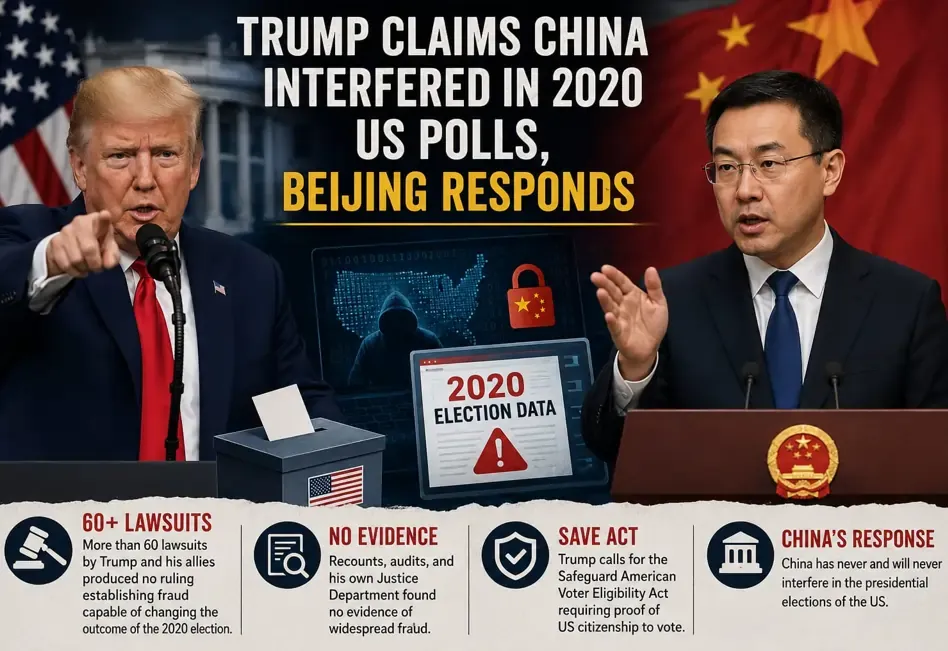
However, allegations that widespread fraud altered the outcome of the 2020 presidential election have repeatedly failed to gain legal backing. More than 60 lawsuits filed by Trump and his allies did not produce any court ruling establishing fraud capable of changing the election result. Recounts, audits and investigations, including those conducted by Trump's own Justice Department, also found no evidence of fraud sufficient to overturn the election outcome.
Trump Pushes SAVE Act
Trump used the address to renew support for the Safeguard American Voter Eligibility (SAVE) Act, legislation that would require documentary proof of US citizenship for individuals registering to vote.
Voting rights organizations have argued that the proposal could make voter registration more difficult for millions of eligible Americans. Under existing federal law, noncitizen voting in federal elections is already illegal and considered rare.
Criticism of Television Networks
The US President also criticized broadcasters that chose not to air his address live, suggesting that networks refusing coverage were contributing to efforts to undermine election integrity.
"They and others in the media are part of a plot. Fraud like this should mean a revocation of their licenses," Trump said while naming ABC and NBC.
China Denies Interference Allegations
Responding to Trump's claims, the Chinese Embassy in the United States rejected the allegations.
"China has all along adhered to the principle of non-interference in other's internal affairs. The US election is an internal matter of the U.S. Its outcome is determined by the votes of the American people. China has never and will never interfere in the presidential elections of the US," Chinese Embassy spokesperson Liu Chang said.
The latest exchange adds to continuing tensions between Washington and Beijing over cybersecurity, election security and broader geopolitical issues, with both governments maintaining sharply different positions on the allegations.
(AI generated Image)