
Healthcare
Understanding the Difference Between Branded and Generic Drugs in India: Why Affordable Healthcare Still Remains Elusive
By MILLENNIUM NEWSROOM Desk · Published: Jun 10, 2026 06:21 AM · Updated: Jul 01, 2026 03:19 AM
6 min read
India is often referred to as the "pharmacy of the world." The country supplies a significant share of the world's generic medicines and is among the largest exporters of affordable pharmaceutical products. Indian pharmaceutical companies manufacture medicines consumed across the United States, Europe, Africa, and Asia, helping millions access life-saving treatments at lower costs.
Yet, a striking paradox remains: despite being a global leader in generic drug manufacturing, India continues to struggle with high out-of-pocket healthcare expenditure, and millions of citizens still find medicines unaffordable.
This contradiction raises an important question: if India produces some of the world's cheapest medicines, why is healthcare still expensive for Indians?
The answer lies partly in understanding the difference between branded and generic drugs, how medicines are prescribed and marketed in India, and why the country's pharmaceutical ecosystem often fails to pass the benefits of low-cost manufacturing to patients.
What Are Generic Drugs?
A generic drug contains the same active pharmaceutical ingredient (API), dosage, strength, safety profile, route of administration, and therapeutic effect as the original medicine.
When a pharmaceutical company develops a new drug, it receives patent protection for a certain period. After the patent expires, other manufacturers can produce the same medicine under its scientific or generic name.
For example:
- Generic name: Paracetamol
- Branded versions: Crocin, Calpol, Dolo-650 and others
The medicine's therapeutic effect remains the same because the active ingredient is identical.
Several studies have found that properly manufactured generic medicines meet the same quality and efficacy standards as their branded counterparts. Recent quality assessments in India found no significant differences in quality between many tested generic and branded medicines despite substantial price variations.
What Are Branded Drugs?
Branded drugs are medicines sold under a company's proprietary brand name.
In India, however, the term "branded drug" often has a different meaning compared to Western markets.
A medicine may have lost patent protection years ago, yet dozens of companies continue selling the same molecule under different brand names. These are commonly known as branded generics.
For example, the molecule Atorvastatin may be available under numerous brand names manufactured by different pharmaceutical companies. While the active ingredient remains identical, prices can vary dramatically.
This unique structure makes India one of the largest markets for branded generics in the world.
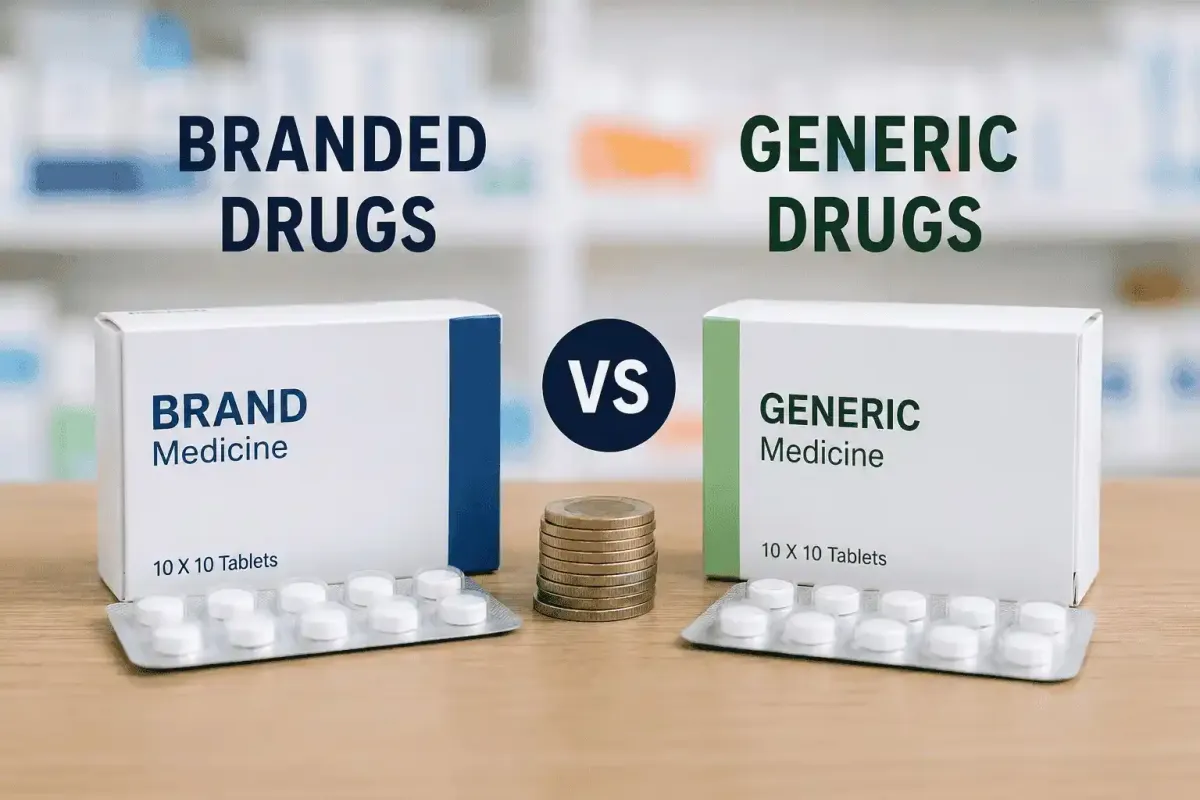
Branded Drugs vs Generic Drugs: Key Differences
| Feature | Generic Drugs | Branded Drugs |
|---|---|---|
| Active Ingredient | Same | Same |
| Therapeutic Effect | Same | Same |
| Regulatory Approval | Required | Required |
| Packaging | Simple | Premium branding |
| Marketing Costs | Lower | Higher |
| Price | Usually lower | Usually higher |
| Doctor Promotion | Limited | Extensive |
The biggest difference is often not the medicine itself but the marketing and branding expenses associated with it.
Pharmaceutical companies spend substantial resources on brand promotion, medical representative networks, physician engagement, conferences, and advertising. These costs are ultimately reflected in medicine prices.
India's Position as a Global Generic Medicine Powerhouse
India's pharmaceutical industry occupies a unique position globally.
- One of the world's largest producers of generic medicines by volume.
- A major supplier of affordable medicines to more than 200 countries.
- Responsible for a significant proportion of generic prescriptions consumed in developed markets.
- A key supplier of low-cost HIV, tuberculosis, diabetes, cardiovascular, and oncology medicines.
Indian generic manufacturers account for billions of dollars in exports annually and supply nearly half of generic prescriptions in the United States.
Why Are Generic Medicines Cheaper?
Generic medicines are cheaper primarily because manufacturers do not incur the enormous research and development costs associated with discovering a new drug.
- Clinical development expenses are already absorbed.
- Manufacturers can focus on production.
- Competition increases.
- Multiple companies enter the market.
- Prices decline significantly.
In theory, this should make healthcare more affordable. In practice, India presents a more complicated picture.
The Rise of Branded Generics in India
Unlike many Western countries where pharmacists commonly substitute generic medicines for branded versions, India's market is dominated by branded generics.
- Patients often purchase a specific brand.
- Pharmacists have limited flexibility to offer cheaper alternatives.
- Price competition becomes less effective.
- Brand recognition influences purchasing decisions.
This creates a marketplace where dozens of brands sell essentially the same molecule at vastly different prices.
The Price Gap Can Be Massive
Numerous studies have documented substantial price differences between branded medicines and generic alternatives.
A 2024 pharmacoeconomic study comparing Jan Aushadhi medicines with branded formulations found that generic medicines were approximately 64.65% less expensive on average.
Another independent quality and cost study found:
- Generic medicines were nearly 49% cheaper on average.
- The most expensive branded medicine cost up to 13.9 times more than the cheapest generic version of the same drug.
- Government-supported generic outlets frequently offered the lowest prices.
Why Is Healthcare Still Expensive in India?
1. Medicines Form a Large Part of Healthcare Spending
Medicines account for a substantial portion of household healthcare expenses in India.
When patients purchase higher-priced branded medicines instead of lower-cost generic alternatives, overall treatment costs rise significantly.
2. Doctor Prescribing Patterns
- Familiarity with specific brands
- Trust in certain manufacturers
- Influence of pharmaceutical marketing
- Concerns about quality consistency
Even when cheaper alternatives exist, patients often follow the prescribed brand.
3. Limited Awareness Among Patients
Many consumers mistakenly believe that higher-priced medicines are more effective.
Recent studies and quality evaluations have repeatedly shown that approved generic medicines can provide the same therapeutic benefits as costlier branded versions.
4. Weak Generic Substitution Practices
India lacks widespread implementation of pharmacist-led generic substitution practices, reducing the cost-saving potential of generic competition.
5. Uneven Availability
Although the government has expanded access through the Pradhan Mantri Bhartiya Janaushadhi Pariyojana (PMBJP), generic outlets are still not uniformly accessible across all regions.
The Role of Jan Aushadhi
The government's Jan Aushadhi initiative was launched to improve access to affordable generic medicines.
- Reduce medicine costs.
- Increase generic drug usage.
- Improve healthcare affordability.
- Reduce out-of-pocket expenditure.
Research comparing Jan Aushadhi medicines with branded alternatives consistently demonstrates significant savings for patients. Studies have reported average cost reductions exceeding 60% for many medicine categories.
Are Generic Medicines Safe?
One of the biggest misconceptions surrounding generic medicines is that they are inferior.
Approved generic medicines must meet regulatory standards for quality, safety, bioequivalence, and manufacturing practices.
- Quality
- Safety
- Bioequivalence
- Manufacturing practices
Recent independent testing of commonly prescribed medicines in India found that sampled medicines, whether branded or generic, met quality standards.
Economic Consequences of High Medicine Costs
- Delayed treatment
- Poor medication adherence
- Treatment interruptions
- Increased hospitalization
- Financial distress
For chronic diseases such as diabetes, hypertension, cardiovascular disorders, and cancer, even small monthly savings can translate into significant long-term benefits.
The Road Ahead
- Greater promotion of generic prescribing.
- Increased public awareness.
- Stronger pharmacist-led generic substitution.
- Wider availability of Jan Aushadhi outlets.
- Continued quality assurance and transparency.
- Better price regulation and monitoring.
The goal should not merely be producing affordable medicines for the world but ensuring that Indian citizens receive the full benefits of the country's pharmaceutical capabilities.
Conclusion
The difference between branded and generic drugs in India is often less about medical effectiveness and more about branding, marketing, and pricing. Generic medicines contain the same active ingredients and are designed to provide the same therapeutic outcomes as their branded counterparts.
India's position as one of the world's largest generic medicine exporters should ideally translate into affordable healthcare for its own population. However, factors such as branded prescribing practices, patient perceptions, uneven access to low-cost medicines, and high out-of-pocket spending continue to limit that potential.
As awareness grows and initiatives such as Jan Aushadhi expand, generic medicines may become one of the most effective tools for reducing healthcare costs and improving access to treatment across India.