
Politics
Kolkata Hawker Evictions Trigger Political Showdown Over Livelihoods, Rehabilitation and Urban Development
By MILLENNIUM NEWSROOM Desk · Published: Jun 03, 2026 04:34 PM · Updated: Jul 01, 2026 03:19 AM
5 min read
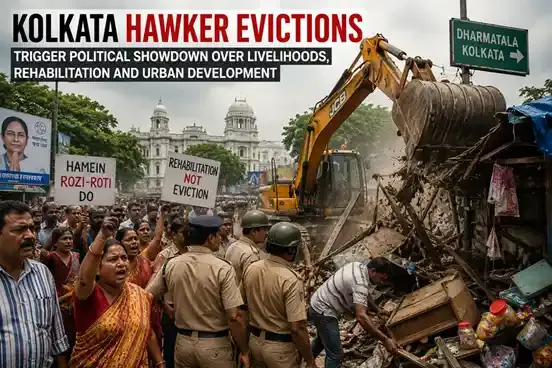
Kolkata, June 2026: The ongoing eviction of hawkers and roadside vendors across Kolkata has emerged as one of the most politically contentious issues in West Bengal, igniting a debate that extends beyond footpath encroachments to questions of livelihood security, urban governance, and public space management.
What began as an anti-encroachment exercise by civic authorities has evolved into a major political flashpoint, drawing criticism from opposition parties, trade unions, and affected vendors while receiving support from sections of the administration that argue for stricter enforcement of urban planning regulations.
Eviction Drive Intensifies Across Key Kolkata Locations
Over the past several weeks, authorities have intensified anti-encroachment operations in multiple parts of Kolkata. Footpath stalls, temporary structures, and roadside establishments identified as unauthorized have been removed as part of efforts to reclaim public spaces, ease pedestrian movement, and improve traffic flow.
The use of bulldozers and demolition squads during several operations has further amplified public attention and political controversy surrounding the campaign.
The impact of the drive has been particularly visible in some of the city's busiest commercial and transport hubs.
- Areas surrounding Howrah Station witnessed large-scale clearance operations targeting roadside stalls and unauthorized structures.
- Eviction drives were also carried out around Sealdah Station, affecting numerous vendors operating in the vicinity.
- In New Market, authorities undertook extensive action across Hogg Street, Bertram Street, Lindsay Street, Humayun Place, Chowringhee Place, and Grand Arcade.
Many vendors in these areas temporarily vacated their stalls amid concerns that further demolition drives could follow. The issue has since spread beyond these locations, generating anxiety among hawkers and small traders across the city.
Government Defends Anti-Encroachment Measures
According to officials, the objective of the campaign is to restore accessibility on footpaths, reduce congestion in commercial districts, and ensure compliance with urban planning norms.
Authorities maintain that decades of unchecked encroachment have significantly restricted pedestrian movement, created safety concerns, and limited the effective use of public infrastructure. They argue that reclaiming public spaces is essential for improving urban mobility and enhancing the overall functioning of the city.
Livelihood Concerns Among Hawkers and Small Traders
While authorities emphasize the need for urban regulation, the evictions have generated widespread concern among thousands of families dependent on informal vending for their daily income.
Many hawkers claim they have operated from the same locations for years and fear that the sudden loss of business could result in severe financial hardship. Vendors have argued that although regulations may be necessary, the absence of a comprehensive rehabilitation framework has left them uncertain about their future.
Several affected traders have expressed concerns that relocation without adequate planning could significantly reduce customer access and earnings, threatening already fragile household incomes.
Political Reactions Intensify
The issue has rapidly become a major point of political confrontation in West Bengal.
"Bulldozers cannot be the language of governance."
Former Chief Minister Mamata Banerjee made the statement while criticizing the eviction drives. The Trinamool Congress (TMC) has since organized protests and public meetings, alleging that the administration is prioritizing demolition over consultation and rehabilitation.
TMC leaders have argued that any effort to reorganize public spaces must be accompanied by a transparent relocation and rehabilitation policy for affected vendors. According to the party, development initiatives should not come at the expense of people whose livelihoods depend on informal economic activities.
Left Parties Demand Vendor Protection
Left parties and affiliated labour organizations have also opposed the eviction campaign. While acknowledging the need for organized urban planning, they have emphasized that street vendors remain an integral component of Kolkata's economic and social ecosystem.
Left-backed groups have called for:
- Creation of designated vending zones
- Legal protection for registered hawkers
- Comprehensive rehabilitation measures
- Consultation with vendor organizations before future eviction drives
Trade unions representing hawkers have similarly argued that the issue extends beyond traffic management and civic administration. According to these organizations, street vending provides employment to thousands of people while also supplying affordable goods and services to residents across the city.
Administration Stresses Public Infrastructure Needs
Supporters of the anti-encroachment campaign contend that public roads and footpaths cannot remain under unauthorized occupation indefinitely.
Government representatives have maintained that restoring public infrastructure is necessary for improving safety, enhancing mobility, and ensuring that citizens can access public spaces without obstruction.
Officials argue that balancing commercial activity with public convenience remains essential for sustainable urban development.
A Broader Urban Challenge
Urban policy experts note that the controversy reflects a challenge faced by cities across India. Rapid urbanization has increased pressure on roads, transport hubs, and public infrastructure, even as a substantial portion of the workforce continues to depend on the informal economy for employment.
As a result, governments frequently face difficult decisions involving the balance between modernization initiatives and livelihood protection.
For many residents, the debate is no longer limited to hawkers or footpath access. It has evolved into a broader discussion about Kolkata's development model and the methods through which urban transformation should be pursued.
Uncertain Road Ahead
Questions surrounding rehabilitation, legal recognition of vendors, and citizens' rights to public spaces are expected to remain central to the discussion in the coming months.
As political parties continue to exchange accusations and affected vendors await clarity regarding their future, the hawker eviction issue is likely to remain at the forefront of West Bengal's political discourse.
Whether authorities can successfully balance urban renewal with social responsibility may ultimately determine how this chapter in Kolkata's evolving urban landscape is remembered.